

Surveys show 40% of event staff experienced communication failure during peak times using only mobile phones. At large-scale events across the UK, reliable communication isn’t just a convenience, it’s a critical safety requirement. When mobile networks buckle under the pressure of thousands of simultaneous connections, event organisers face serious coordination breakdowns that can escalate into dangerous situations. This guide explains why professional radio communications remain indispensable for successful event management, offering instant connectivity, network independence, and integration with advanced safety technologies that smartphones simply cannot match.
Table of Contents
- Understanding Event Communication Challenges
- Technical Advantages Of Radio Communications For Events
- Safety And Coordination Benefits Of Radios In Event Management
- Common Misconceptions About Using Radio Communications At Events
- Comparison Of Analog And Digital Radio Technologies
- Implementing Radio Communication Systems For Large-Scale Events
- Conclusion: Maximising Event Success With Reliable Radio Communications
- Explore Professional Radio Communication Solutions From Smye-Rumsby
- Frequently Asked Questions
Key takeaways
| Point | Details |
|---|---|
| Network independence | Radios operate without relying on congested cellular networks, preventing communication blackouts during peak attendance periods. |
| Instant communication | Push-to-talk functionality delivers sub-second response times, eliminating the delays of dialling and connecting phone calls. |
| Enhanced safety | Integration with body cameras and smart sensors enables real-time monitoring and 30% faster emergency responses. |
| Superior technology | Digital radios provide 50% clearer audio, stronger encryption, and up to 40% longer battery life than analog systems. |
| Proven reliability | Digital radio adoption in event management has risen 35% from 2022 to 2025, reflecting growing professional trust. |
Understanding event communication challenges
Event organisers face unique communication obstacles that mobile phones struggle to overcome. The sheer volume of attendees at festivals, concerts, sporting events, and conferences creates network congestion that brings cellular systems to their knees. When thousands of people attempt simultaneous calls, texts, and data usage, mobile networks become oversaturated, leading to dropped connections and failed messages at the worst possible moments.
Physical venue characteristics compound these problems. Large outdoor spaces, multi-level structures, underground areas, and buildings with thick walls create signal dead zones where mobile reception vanishes completely. Event staff moving between these areas lose contact precisely when coordination matters most.
The nature of event work demands instant, clear communication across multiple teams. Security personnel, medical staff, technical crews, and management all require immediate contact to respond to incidents, coordinate logistics, and maintain safety protocols. Mobile phones force users through multiple steps: unlock device, find contact, dial, wait for connection. This delay can prove catastrophic during emergencies.
Key communication challenges at large events include:
- Mobile phone networks often become overloaded at events causing communication failures
- Signal interference from venue structures and crowd density
- Battery drain from constant searching for weak cellular signals
- Inability to broadcast messages simultaneously to entire teams
- Delayed response times when seconds matter for safety
Professional two way radio hire for events addresses these challenges directly. Organisations like Dover Castle have implemented two-way radio installation to maintain reliable communication across complex historic venues where mobile coverage proves unreliable.
Technical advantages of radio communications for events
Radio technology delivers specific technical capabilities that make it superior to smartphones for event coordination. Understanding these advantages helps organisers make informed decisions about communication infrastructure.
Push-to-talk functionality represents the most significant operational advantage. Two-way radios provide sub-second push-to-talk functionality, allowing users to broadcast messages instantly by pressing a single button. There’s no dialling, no ringing, no waiting for someone to answer. The entire team hears critical information simultaneously, ensuring coordinated responses.
Network independence ensures reliability when it matters most. Radios operate on dedicated frequencies that don’t rely on cellular infrastructure. When mobile networks collapse under user volume, radios continue functioning normally. This independence proves invaluable in emergencies when communication failure could endanger lives.
Digital Mobile Radio (DMR) technology has revolutionised audio quality and efficiency. Digital systems eliminate the static and interference that plagued analog radios, delivering crystal-clear voice transmission even in noisy environments. Background noise cancellation allows users to understand messages in crowded, loud venues where mobile phone conversations become impossible.
Battery performance far exceeds smartphones. Digital radios can operate for 18 to 24 hours on a single charge, while analog systems typically last 12 to 16 hours. Smartphones, constantly searching for cellular signals and running background applications, rarely survive a full event day without recharging.
Key technical advantages include:
- Instant group communication without dialling individual contacts
- Dedicated frequency channels preventing interference and eavesdropping
- Rugged construction withstanding drops, moisture, and extreme temperatures
- Consistent coverage across entire venue footprints
- Private and group channel options for organised team communication
Pro Tip: When hiring two-way radios, specify digital systems for events requiring clear communication in noisy environments or enhanced security features.
Modern systems like Hytera multi-mode radios bridge analog and digital technologies, allowing organisations to upgrade gradually whilst maintaining compatibility with existing equipment.
Safety and coordination benefits of radios in event management
The measurable safety improvements from professional radio systems justify their adoption across the UK events industry. Dedicated communication channels create organised information flow that prevents the chaos of multiple overlapping conversations.
Emergency response times improve dramatically with instant radio communication. Studies demonstrate two-way radios enable 30% faster emergency responses compared to mobile phone coordination. When medical incidents, security threats, or crowd control situations develop, every second counts. The ability to alert all relevant personnel simultaneously and coordinate their movements in real time can literally save lives.
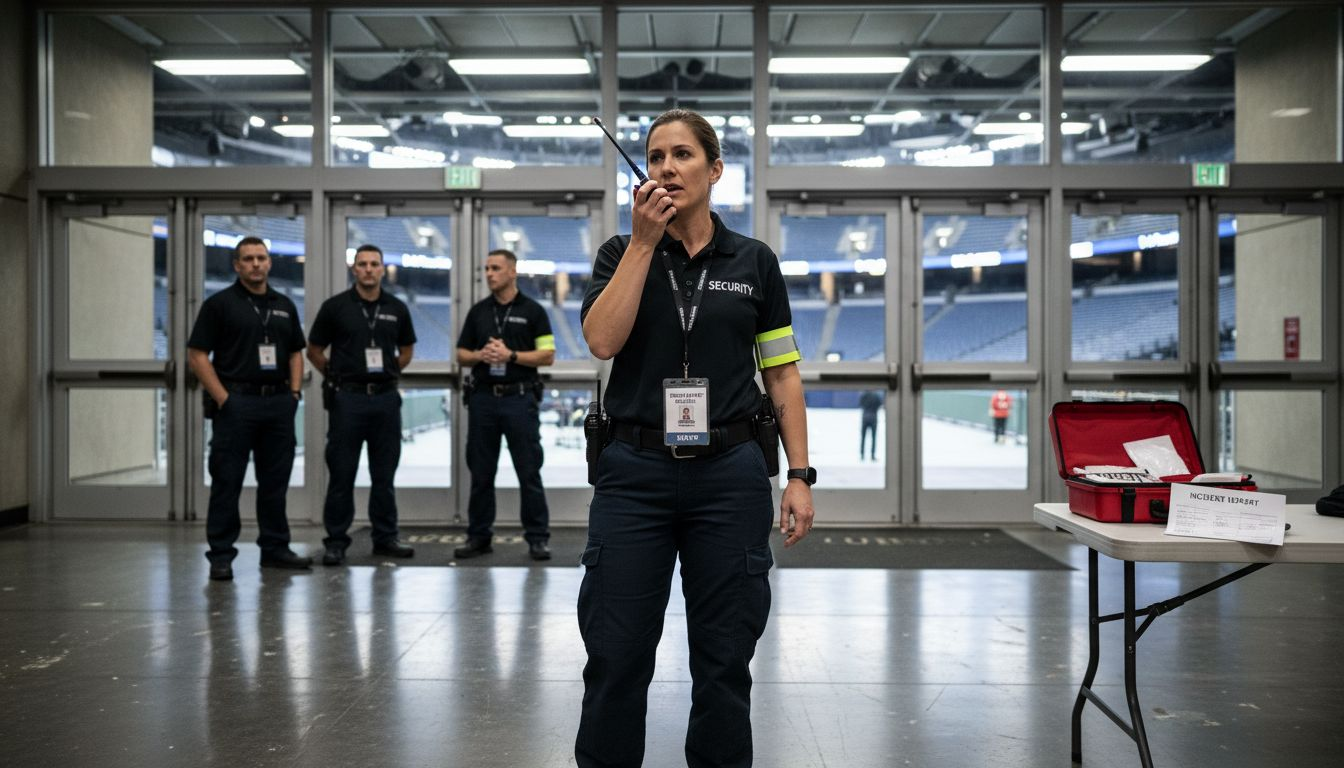
Integration with body-worn cameras and smart sensors creates comprehensive safety monitoring systems. Security teams can review incidents immediately, management can verify protocol compliance, and evidence is captured automatically. Environmental sensors detect overcrowding, temperature extremes, or hazardous conditions, triggering instant radio alerts to response teams.
Dedicated frequency channels eliminate miscommunication by separating different operational functions:
- Security teams operate on protected channels for sensitive information
- Medical staff coordinate patient care without interference
- Technical crews manage equipment and infrastructure
- Management oversees operations with priority access to all channels
- Emergency channels remain clear for crisis response
Real-time coordination capabilities include:
- Broadcasting evacuation instructions to all staff simultaneously
- Directing security resources to developing incidents
- Coordinating medical response with precise location information
- Monitoring crowd density and movement patterns
- Tracking staff locations and welfare throughout events
A major UK music festival reported a 45% reduction in incident response times and 60% fewer communication-related errors after implementing digital radio systems integrated with body worn cameras across their security teams.
Clear, reliable communication creates a safety culture where staff feel confident reporting concerns immediately. This proactive approach prevents small issues from escalating into major incidents.
Common misconceptions about using radio communications at events
Many event organisers dismiss radios as outdated technology, assuming smartphones have rendered them obsolete. This misconception persists despite overwhelming evidence that professional radio systems deliver superior performance in event environments.
The myth of obsolescence collapses when examining adoption trends. Digital radio use in event management has risen 35% from 2022 to 2025, reflecting growing professional recognition of their advantages. Major venues, festivals, and corporate events increasingly specify radio systems as essential infrastructure, not optional extras.
Smartphones suffer fundamental limitations in group communication scenarios. Broadcasting a message to 50 security staff requires 50 individual phone calls or hoping everyone reads a group text promptly. Radio systems deliver that message instantly to all recipients simultaneously, ensuring coordinated action.
Network congestion creates unpredictable failures that compromise safety. An organiser cannot know whether their critical message will reach recipients during peak usage periods. This uncertainty is unacceptable when managing crowd safety, medical emergencies, or security threats.
Key misconceptions and realities:
- Myth: Radios are old technology replaced by smartphones
- Reality: Digital radios incorporate cutting-edge technology superior to consumer mobile devices for professional applications
- Myth: Mobile phones are more convenient and familiar
- Reality: Radios require minimal training and eliminate the complexity of managing contact lists and apps
- Myth: Radio systems are prohibitively expensive
- Reality: Hiring arrangements provide affordable access without capital investment, and prevented incidents far exceed costs
“After experiencing multiple communication breakdowns using mobile phones at our summer festival, switching to professional radio systems transformed our operations. Response times improved dramatically, staff coordination became seamless, and we finally achieved the safety standards we’d been struggling to maintain.” — Events Manager, Major UK Outdoor Venue
Relying exclusively on smartphones creates vulnerability that becomes apparent only during crises when communication matters most. The benefits of hiring two-way radios include eliminating this risk through proven, dependable technology designed specifically for professional coordination requirements.
Comparison of analog and digital radio technologies
Choosing between analog and digital radio systems requires understanding their distinct capabilities and limitations. Both technologies serve professional communication needs, but digital systems offer substantial advantages for modern event environments.
| Feature | Analog radios | Digital radios |
|---|---|---|
| Audio quality | Susceptible to static and interference | 50% clearer audio and enhanced security features |
| Battery life | 12 to 16 hours typical | Up to 40% longer, 18 to 24 hours |
| Security | Basic scrambling, easily intercepted | Strong encryption prevents eavesdropping |
| Noise cancellation | Limited background noise filtering | Advanced digital noise suppression |
| Data capability | Voice only | Voice plus text messaging and GPS tracking |
| Coverage efficiency | Requires more power for equivalent range | More efficient signal transmission |
| Cost | Lower initial investment | Higher upfront cost, better long-term value |
| Compatibility | Works only with other analog units | Can support mixed analog/digital fleets |
Digital systems excel in noisy environments where clear communication proves challenging. Music festivals, sporting events, and crowded exhibitions generate ambient noise that degrades analog transmissions. Digital audio processing filters background noise, delivering intelligible messages even when shouting would be required on analog systems.
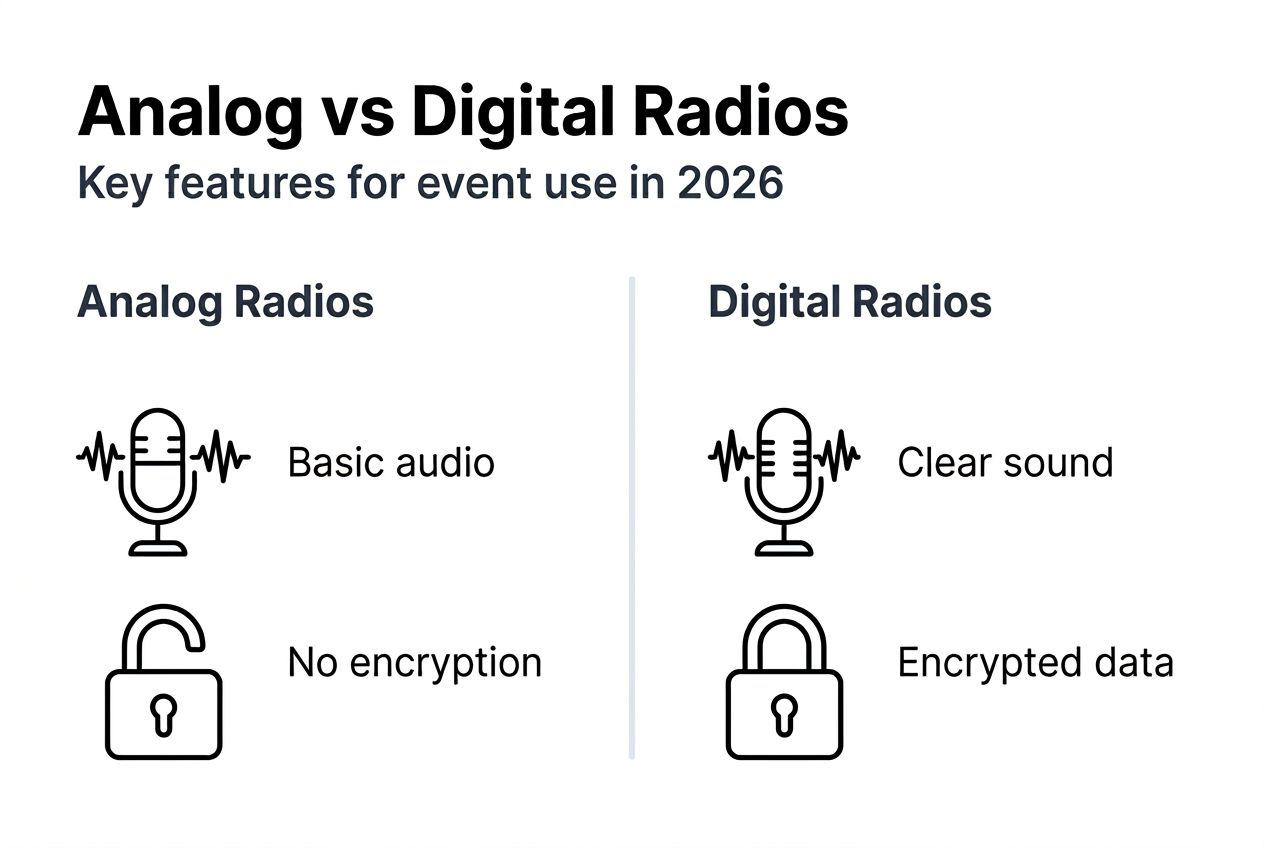
Encryption protects sensitive operational information from interception. Security protocols, VIP movements, and incident response details remain confidential, preventing potential threats from monitoring communications. Analog scrambling provides minimal protection that determined listeners can easily bypass.
Battery efficiency stems from digital radios transmitting only when the push-to-talk button is pressed, whilst analog systems consume power continuously to maintain channel monitoring. This efficiency extends operational time and reduces the logistical burden of battery management during long events.
Advanced features available on digital platforms include:
- Text messaging for non-urgent updates without interrupting voice channels
- GPS tracking showing real-time staff locations
- Emergency alert buttons sending instant distress signals
- Programmable buttons for quick access to specific functions
- Integration with computer-aided dispatch systems
Pro Tip: Consider mixed fleets radio solutions when transitioning from analog to digital, allowing gradual fleet upgrades whilst maintaining interoperability across all devices.
Event size and complexity should guide technology selection. Small events with basic coordination needs may function adequately with analog systems. Large-scale events requiring robust security, multiple team coordination, and technology integration benefit significantly from digital platforms despite higher costs.
Implementing radio communication systems for large-scale events
Successful radio system deployment requires careful planning that addresses venue characteristics, team structures, and operational requirements. Following proven implementation practices maximises communication effectiveness and return on investment.
Venue assessment forms the foundation of system design. Walk the entire site identifying coverage challenges: underground areas, dense structures, outdoor perimeters, and high-capacity zones where crowds might interfere with signals. Ensuring dedicated channels and repeaters extends communication range across venues with complex layouts or large footprints.
Repeaters amplify radio signals, dramatically extending coverage beyond line-of-sight limitations. Positioning repeaters strategically on elevated structures or central locations creates overlapping coverage zones ensuring no dead spots. Large venues typically require multiple repeaters to achieve complete coverage.
Implementation steps for optimal performance:
- Map venue layout identifying potential signal obstacles and coverage gaps
- Calculate user requirements based on team sizes and communication frequency
- Design channel allocation separating operational functions to prevent interference
- Install repeaters and test coverage across all critical areas
- Programme radios with appropriate channels, emergency features, and user permissions
- Conduct comprehensive team training covering normal operations and emergency procedures
- Establish battery management protocols ensuring devices remain operational throughout events
- Create contingency plans for equipment failure or unexpected communication challenges
Channel management prevents chaos during high-pressure situations:
- Assign dedicated channels to distinct operational teams
- Reserve emergency channels for crisis communication only
- Establish clear protocols for channel switching during multi-team coordination
- Limit access to sensitive channels based on security clearances
- Designate management channels for executive decision-making
Training ensures teams utilise systems effectively. Cover basic operation, channel selection, emergency procedures, and integration with other technologies. Practice realistic scenarios where multiple teams coordinate responses to simulated incidents.
Integration opportunities enhance operational capabilities:
- Connect radios to body cameras for incident documentation
- Link environmental sensors triggering automatic alerts
- Integrate access control systems coordinating security responses
- Connect public address systems for crowd management
- Interface with venue management software tracking resources and incidents
Pro Tip: Schedule radio distribution at least one hour before event start, allowing time to verify functionality, resolve technical issues, and ensure every team member receives proper equipment and understands their assigned channels.
Explore comprehensive two-way radio products designed for diverse event requirements, or consider flexible two-way radio hire for events eliminating capital investment whilst accessing professional-grade equipment.
Conclusion: maximising event success with reliable radio communications
Professional radio communication systems deliver measurable improvements in safety, coordination, and operational efficiency that mobile phones cannot match. Network independence ensures communication reliability regardless of cellular congestion, whilst push-to-talk functionality enables instant team coordination during time-critical situations.
Digital radio technology has transformed these systems from basic voice communication into comprehensive safety platforms. Enhanced audio clarity, extended battery life, strong encryption, and integration with cameras and sensors create interconnected operational ecosystems that protect attendees and staff alike.
The evidence is clear: organisations adopting professional radio systems experience faster emergency responses, fewer communication errors, and improved incident outcomes. As event complexity and attendance continue growing across the UK, reliable communication infrastructure becomes increasingly essential for success and safety.
Event organisers must recognise that communication failures create unacceptable risks. Investing in proven radio technology protects attendees, enhances coordination, and ensures events proceed smoothly from setup through breakdown. The question isn’t whether to implement radio systems, but rather how quickly organisations can deploy them.
Explore professional radio communication solutions from Smye-Rumsby
After understanding why radio communications can prove essential for event success, the next step involves partnering with experienced providers who deliver reliable, professional-grade equipment.
Smye-Rumsby has equipped UK events with dependable communication solutions since 1948, serving organisers across the South East with tailored two-way radio hire for events of all scales. Whether managing intimate conferences or massive festivals, their expert team designs systems matching your specific venue and operational requirements.
Hiring rather than purchasing offers significant advantages. Eliminate capital investment whilst accessing the latest digital technology. Scale equipment quantities precisely to event size. Receive pre-configured devices ready for immediate deployment. Professional support ensures technical issues never disrupt operations.
Discover radio hire advantages that provide flexibility, cost efficiency, and peace of mind. For venues requiring permanent infrastructure, comprehensive radio installation services deliver customised solutions with ongoing maintenance and support. Contact Smye-Rumsby to discuss your event communication needs and ensure reliable coordination throughout your next event.
Frequently asked questions
Are two-way radios still effective compared to smartphones in 2026?
Absolutely. Radios provide instant push-to-talk functionality and operate independently of cellular networks, making them crucial when mobile networks become congested at busy events. Smartphones suffer from delays, dropped connections, and battery drain that radios avoid entirely. Professional event organisers increasingly specify radio systems as essential safety infrastructure.
How do digital radios improve safety at large events?
Digital systems deliver significantly clearer audio that reduces miscommunication and operational errors. Encryption protects sensitive security communications from interception. Integration with body cameras and sensors enables real-time monitoring and faster incident response. These features combine to create comprehensive safety platforms that smartphones cannot replicate.
What are the key factors when choosing a radio system for an event?
Prioritise coverage and range suitable for your venue’s size and complexity. Evaluate audio clarity and noise cancellation capabilities for your environment. Ensure battery life exceeds your event duration with safety margin. Consider security features like encryption for sensitive operations. Assess the ability to integrate with body cameras, sensors, and other safety technologies you already use.
Can radios be integrated with other security technologies during events?
Modern radio systems support extensive integration with complementary security equipment. Body-worn cameras connect to radios, allowing incident documentation triggered by radio activity. Smart environmental sensors send automatic alerts through radio networks when detecting hazards. GPS tracking shows real-time staff locations. These integrations create unified safety platforms far exceeding standalone smartphone capabilities. Review body-worn camera considerations to understand integration opportunities.
Recommended
- Two Way Radio Hire For Events – Smye-Rumsby – Experts in Two-Way Radios and Marine Electronics
- [2024] Radio Communications Hire Fleet – Smye-Rumsby – Experts in Two-Way Radios and Marine Electronics
- Why hire a two-way radio instead of purchase? – Smye-Rumsby – Experts in Two-Way Radios and Marine Electronics
- Radio Solutions for Mixed Fleets (Analogue & Digital) – Smye-Rumsby – Experts in Two-Way Radios and Marine Electronics