
Radio frequencies often appear complex and intimidating to professionals outside telecommunications, yet they underpin every reliable communication system in security and construction sectors. These electromagnetic waves enable instant coordination across job sites, rapid emergency response, and secure team communication in challenging environments. Understanding radio frequencies transforms how you select, deploy, and maintain communication equipment, directly impacting operational safety and efficiency. This guide demystifies radio frequency technology, explaining spectrum basics, frequency band applications, and practical implementation strategies tailored for critical communication professionals working in demanding field conditions.
Table of Contents
- Understanding Radio Frequencies: Definitions And Spectrum Basics
- How Radio Frequencies Support Critical Communication Sectors
- Comparing Frequency Bands Used In Security And Construction Communication
- Implementing Radio Frequency Communication: Practical Steps And Considerations
- Enhance Your Communication With Smye-Rumsby Solutions
Key takeaways
| Point | Details |
|---|---|
| Radio frequencies enable critical communication | Electromagnetic waves between 3 kHz and 300 GHz power two-way radios and digital mobile radio systems used across security and construction sectors. |
| Different frequency bands serve distinct needs | VHF provides longer range for outdoor work whilst UHF penetrates buildings effectively, requiring careful selection based on operational environment. |
| Proper implementation enhances safety | Choosing appropriate frequency bands, maintaining equipment correctly, and training staff thoroughly maximises communication reliability during emergencies. |
| Regulatory compliance remains essential | UK spectrum regulations in 2026 require proper licensing and adherence to safety standards for professional radio frequency equipment. |
Understanding radio frequencies: definitions and spectrum basics
Radio frequencies represent a specific portion of the electromagnetic spectrum, typically ranging from 3 kilohertz to 300 gigahertz. These electromagnetic waves travel through space at the speed of light, carrying information between transmitters and receivers in radio frequency systems used throughout professional communication networks. Frequency measures how many wave cycles occur per second, expressed in hertz, whilst wavelength describes the physical distance between wave peaks.
The electromagnetic spectrum divides into distinct bands, each offering unique properties for communication applications. Low frequency bands travel further but carry less information, whilst higher frequencies support more data but cover shorter distances. Digital mobile radio systems utilise specific frequency ranges optimised for clear, secure communication in critical sectors.
Professional communication typically employs four primary frequency bands:
- Very High Frequency (VHF) spans 30 to 300 megahertz, ideal for outdoor communication across open terrain and longer distances
- Ultra High Frequency (UHF) covers 300 to 3000 megahertz, excelling at penetrating buildings and navigating urban environments
- Super High Frequency (SHF) ranges from 3 to 30 gigahertz, supporting high-capacity data transmission over shorter ranges
- Extremely High Frequency (EHF) extends from 30 to 300 gigahertz, enabling specialised applications requiring substantial bandwidth
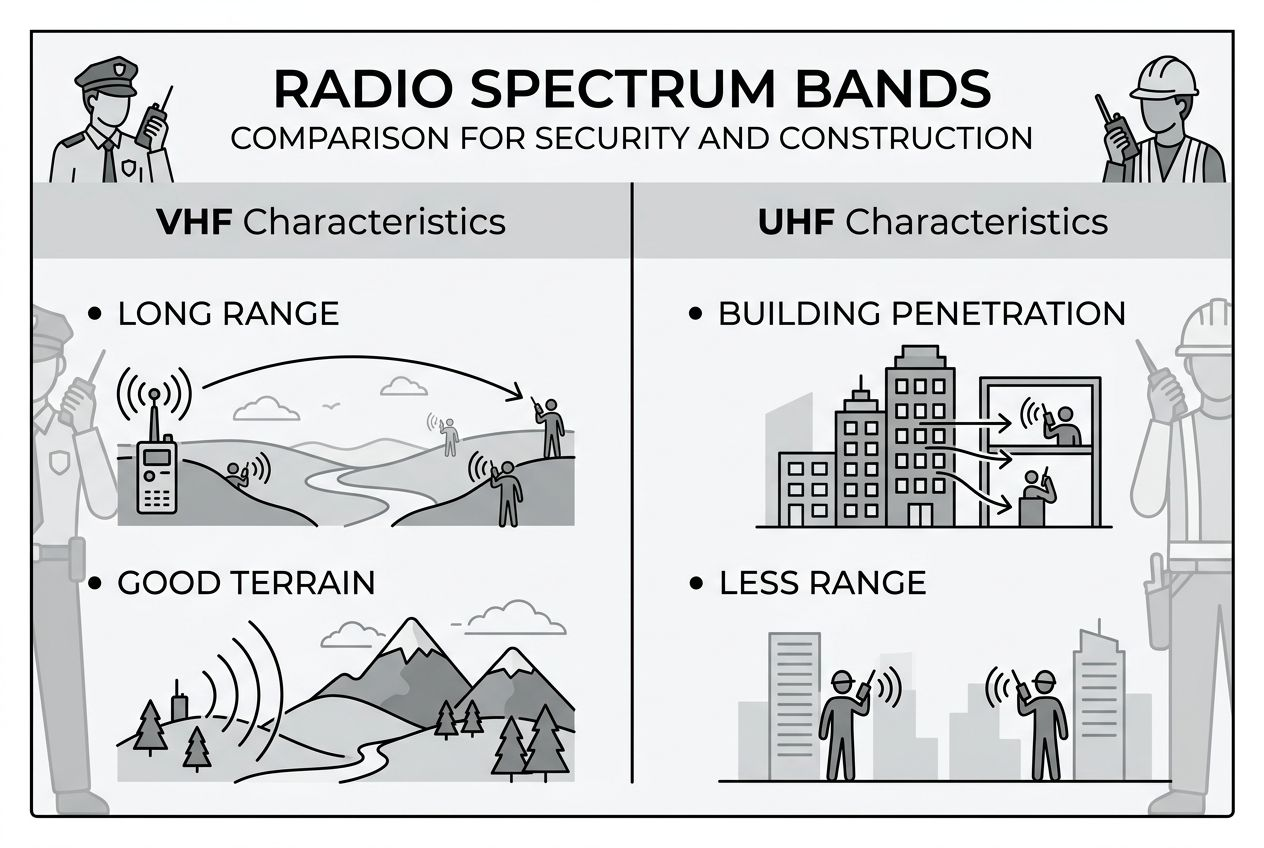
Frequency choice dramatically affects communication performance in real-world conditions. Lower frequencies bend around obstacles and follow terrain contours more effectively, making VHF suitable for rural construction sites or perimeter security across expansive properties. Higher frequencies like UHF propagate in straighter lines, bouncing off surfaces and penetrating concrete structures, which proves invaluable for multi-storey building projects or indoor security operations.
Wavelength inversely relates to frequency, creating practical implications for antenna design and equipment portability. VHF systems require longer antennas due to extended wavelengths, whilst UHF equipment uses compact antennas that integrate seamlessly into body-worn devices. Understanding these fundamental relationships helps professionals select appropriate radio equipment matching their operational requirements and environmental constraints.
Pro Tip: Test radio equipment in your actual working environment before committing to a frequency band, as building materials, terrain features, and electromagnetic interference vary significantly between locations and can dramatically impact communication range and clarity.
How radio frequencies support critical communication sectors
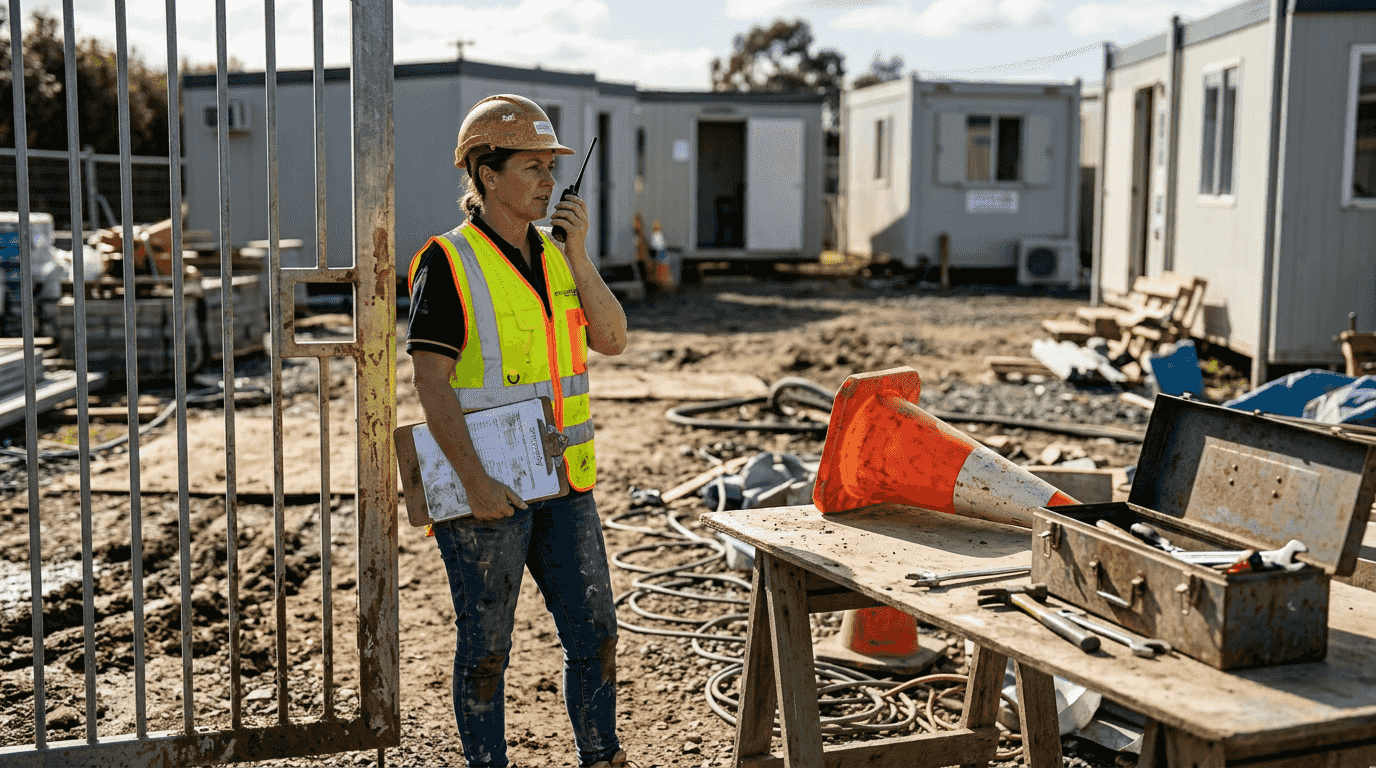
Radio frequencies form the backbone of instant communication in security and construction environments where mobile phone networks prove unreliable or insufficient. Two-way radios using specific frequencies enable immediate coordination during emergencies, equipment failures, or security incidents without depending on cellular infrastructure. Security personnel monitoring large sites rely on VHF for perimeter coverage, whilst construction teams working inside structures benefit from UHF’s superior building penetration.
Digital mobile radio technology leverages radio frequencies to deliver encrypted, interference-resistant communication channels. DMR systems compress voice data efficiently, allowing multiple conversations to share the same frequency band without mutual interference. This spectrum efficiency proves crucial as available frequencies become increasingly congested across urban areas and industrial zones.
Reliable radio frequency communication delivers measurable safety and operational benefits:
- Instant group communication enables rapid response to accidents, security breaches, or equipment malfunctions across dispersed teams
- Direct push-to-talk functionality eliminates dialling delays, connecting workers immediately during time-critical situations
- Dedicated frequencies avoid network congestion affecting public mobile services during major incidents or peak usage periods
- Encrypted digital channels protect sensitive security communications and proprietary construction project information
Challenges accompany radio frequency deployment in professional settings. Electromagnetic interference from electrical equipment, metal structures, and other radio systems can degrade signal quality or create dead zones. Spectrum allocation regulations limit which frequencies organisations may use without licensing, requiring careful planning and compliance with Ofcom requirements. Environmental factors like weather conditions, building density, and terrain features affect propagation patterns differently across frequency bands.
Professionals must balance these technical constraints against operational requirements. A security firm covering a rural estate prioritises VHF for maximum range, accepting larger equipment size. Construction managers working on high-rise projects select UHF despite shorter outdoor range, valuing reliable floor-to-floor communication. Understanding how radio frequencies interact with physical environments enables informed decisions about two-way radio applications tailored to specific sector needs.
Pro Tip: Conduct a site survey measuring signal strength at critical locations before deploying radio systems, identifying potential interference sources and dead zones that require repeaters or alternative frequency selection to ensure comprehensive coverage.
Comparing frequency bands used in security and construction communication
Selecting appropriate frequency bands requires understanding how different portions of the radio spectrum perform under varying operational conditions. Professional communication systems employ distinct frequency ranges, each offering specific advantages and limitations affecting range, penetration, and reliability.
| Frequency band | Typical range | Primary use cases | Building penetration | Interference susceptibility |
|---|---|---|---|---|
| VHF (30-300 MHz) | 5-10 km outdoors | Rural security, outdoor construction, perimeter monitoring | Poor to moderate | Lower, fewer competing devices |
| UHF (300-3000 MHz) | 2-5 km outdoors | Urban security, indoor construction, multi-storey buildings | Excellent | Moderate, more crowded spectrum |
| 800-900 MHz | 3-8 km outdoors | Public safety, large facilities, campus security | Very good | Higher in urban areas |
VHF frequencies excel in environments with minimal physical obstructions. The longer wavelengths curve around hills and penetrate foliage more effectively than higher frequencies, making VHF ideal for agricultural security, outdoor events, or construction projects spanning large open areas. However, these same wavelengths struggle to penetrate modern building materials like reinforced concrete and metallised glass.
UHF frequencies dominate indoor professional communication due to superior building penetration and reflection characteristics. Shorter wavelengths bounce off walls and ceilings, reaching areas VHF signals cannot access. Construction sites with multiple structures, underground areas, or steel frameworks benefit significantly from UHF’s ability to navigate complex built environments. Urban security operations similarly favour UHF for reliable communication through buildings and around obstacles.
Key selection factors for professionals include:
- Outdoor operations across open terrain favour VHF for maximum range and minimal equipment cost
- Indoor work within buildings, tunnels, or confined spaces requires UHF for reliable penetration and coverage
- Mixed environments benefit from dual-band systems supporting both VHF and UHF frequencies
- High-density urban areas may necessitate higher frequencies to access less congested spectrum portions
Antenna requirements differ substantially between bands. VHF systems need longer antennas, sometimes extending 30 to 50 centimetres, which can prove cumbersome for body-worn applications. UHF antennas measure just 8 to 15 centimetres, integrating seamlessly into compact portable radios. This physical difference influences equipment selection for professional radio users prioritising mobility and discretion.
Pro Tip: Prioritise UHF for construction projects involving multiple floors or significant structural complexity, reserving VHF for security operations covering large outdoor perimeters where maximum range outweighs building penetration requirements.
Implementing radio frequency communication: practical steps and considerations
Successfully deploying radio frequency communication systems requires methodical planning, appropriate equipment selection, and ongoing maintenance aligned with operational requirements. Professionals must navigate technical specifications, regulatory compliance, and practical constraints to establish reliable communication networks.
Follow these steps when implementing radio frequency solutions:
- Assess your operational environment, identifying coverage areas, building types, terrain features, and potential interference sources that influence frequency selection.
- Determine user requirements including number of radios, typical communication patterns, privacy needs, and integration with existing systems.
- Select appropriate frequency bands based on environment assessment, balancing range, penetration, and equipment portability.
- Verify licensing requirements with Ofcom for your chosen frequencies, obtaining necessary permissions before equipment deployment.
- Choose radio equipment from reputable manufacturers offering proven reliability in similar professional applications.
- Conduct thorough site testing before full deployment, confirming coverage and identifying dead zones requiring repeaters or additional infrastructure.
- Implement comprehensive user training covering basic operation, emergency procedures, and maintenance responsibilities.
Equipment safety and maintenance practices directly impact communication reliability:
- Inspect antennas regularly for damage, ensuring secure connections and proper orientation
- Clean radio housings and charging contacts to prevent corrosion affecting performance
- Replace batteries according to manufacturer schedules, avoiding degraded capacity during critical operations
- Store equipment in controlled environments protecting against moisture, extreme temperatures, and physical damage
- Maintain detailed service records tracking inspections, repairs, and component replacements
Regulatory compliance in 2026 requires attention to UK spectrum management rules. Ofcom allocates specific frequency bands for different uses, with some requiring individual licensing whilst others operate under light licensing or licence-exempt frameworks. Professional organisations typically need business radio licences specifying authorised frequencies, power levels, and operational areas. Violating spectrum regulations risks substantial fines and equipment confiscation.
Common implementation pitfalls include:
- Underestimating building penetration challenges, leading to inadequate indoor coverage
- Selecting frequencies based solely on equipment cost rather than operational suitability
- Neglecting regular maintenance schedules, allowing minor issues to escalate into communication failures
- Insufficient user training resulting in improper radio operation and reduced effectiveness
- Failing to plan for growth, deploying systems lacking scalability for expanding operations
Professionals should consider whether radio hire or purchase better suits their needs. Short-term projects or seasonal operations benefit from rental arrangements avoiding capital expenditure and maintenance responsibilities. Long-term deployments justify equipment purchase, particularly when integrated with broader safety protocols and operational procedures.
Pro Tip: Establish clear communication protocols and standard operating procedures before deploying radio systems, ensuring all users understand channel assignments, emergency codes, and proper radio etiquette that maximises network efficiency and prevents confusion during critical incidents.
Enhance your communication with Smye-Rumsby solutions
Navigating radio frequency technology becomes straightforward with expert guidance tailored to critical communication sectors. Smye-Rumsby has equipped security and construction professionals across the South East since 1948, delivering reliable two-way radio systems matched precisely to operational requirements.
Whether your project demands short-term equipment hire or permanent communication infrastructure, our specialists help you select optimal frequency bands and radio systems. Explore why hiring two-way radios offers flexibility for temporary projects, or discover practical applications demonstrating how professionals enhance safety and coordination. Browse our comprehensive range of radio communication products featuring leading manufacturers like Motorola and Kenwood, backed by installation, maintenance, and repair services ensuring your systems perform reliably when communication matters most.
What are radio frequencies?
What frequency range defines radio frequencies?
Radio frequencies span the electromagnetic spectrum from 3 kilohertz to 300 gigahertz, encompassing the bands used for wireless communication, broadcasting, and professional two-way radio systems. Different portions serve distinct purposes, with VHF and UHF bands most common in security and construction applications.
Which frequency band works best for indoor construction communication?
UHF frequencies between 400 and 470 megahertz provide superior building penetration for indoor construction sites. These shorter wavelengths navigate concrete, steel, and multiple floors more effectively than VHF, ensuring reliable communication throughout complex structures and confined spaces.
Do I need a licence to operate professional radio equipment in the UK?
Most professional radio systems require business radio licences from Ofcom in 2026, specifying authorised frequencies and operational parameters. Some low-power devices operate under light licensing frameworks, but critical communication applications typically need individual licences ensuring interference-free operation and regulatory compliance.
How do radio frequencies improve workplace safety?
Radio frequencies enable instant communication during emergencies, equipment failures, or security incidents without depending on mobile networks. Direct push-to-talk functionality connects dispersed teams immediately, whilst encrypted digital channels protect sensitive information and dedicated frequencies avoid congestion affecting public services during major incidents.
What maintenance do radio frequency systems require?
Regular inspection of antennas, cleaning of charging contacts, battery replacement according to manufacturer schedules, and systematic maintenance workflows ensure reliable performance. Professional systems benefit from scheduled servicing by qualified technicians who verify transmitter output, receiver sensitivity, and overall system integrity preventing communication failures during critical operations.