
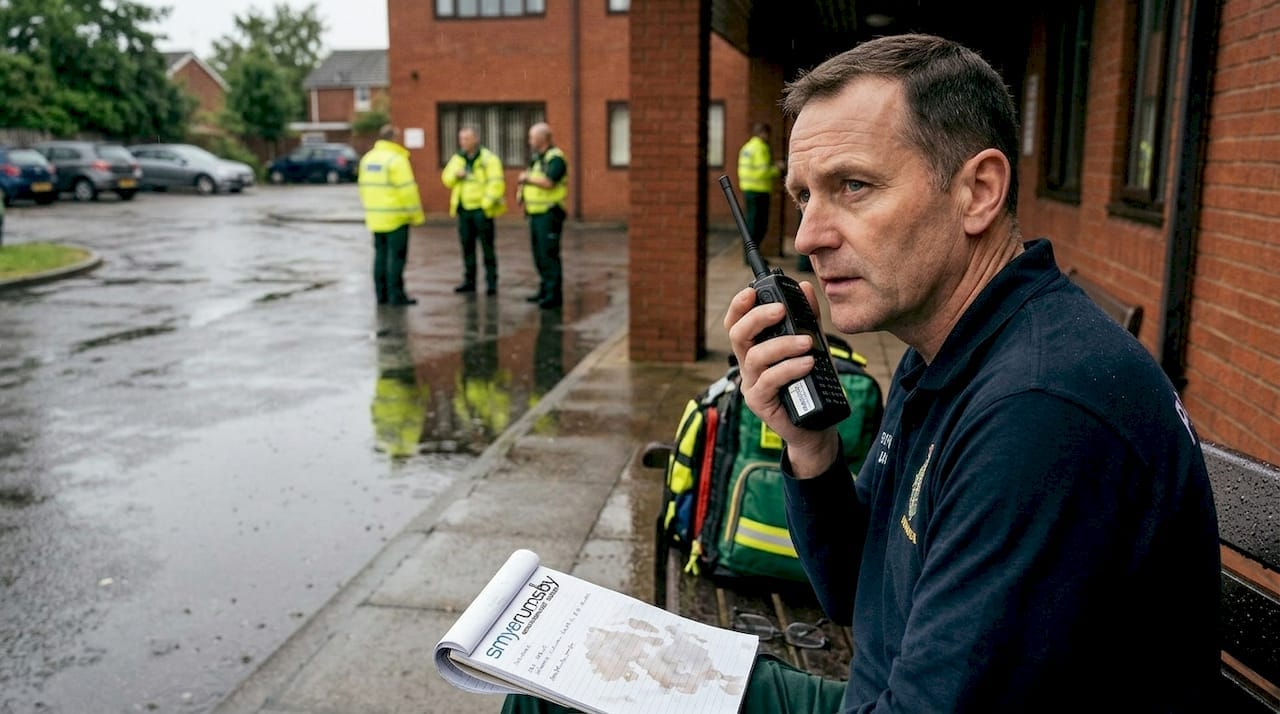
- Two-way radios are essential for emergency response because they operate independently of cellular networks and offer instant communication.
- Resilience during disasters relies on backup power, DMO, and portable repeaters to maintain communication when infrastructure fails.
- Effective emergency communication requires regular testing, documented protocols, training, and backup power solutions to ensure reliability.
When a major incident unfolds, however, the assumption that a mobile phone will suffice can put lives at risk. Network congestion, power outages, and infrastructure failure routinely render cellular systems unreliable at the worst possible moments. For decades, two-way radios have served as the communication backbone for UK emergency services and safety professionals, and that role has not diminished. This guide examines why two-way radios remain indispensable, how they perform under real crisis conditions, which technical features matter most, and what best practices will keep your team ready when it counts.
Table of Contents
- Why two-way radios matter in critical incidents
- How two-way radios ensure resilience during disasters
- Technical features that support emergency coordination
- Best practices for deployment and ongoing preparedness
- A modern perspective: The overlooked essentials most plans miss
- How to strengthen your emergency communications strategy
- Frequently asked questions
Key Takeaways
| Point | Details |
|---|---|
| Push-to-talk reliability | Two-way radios enable instant, direct communication vital for emergency response. |
| Network independence | In power outages and network failures, radios with DMO continue to function when mobiles cannot. |
| Technical features matter | Capabilities like group calls, TDMA, and encryption make radios the backbone of coordination. |
| Plan for redundancy | Backup power sources and regular drills help ensure continuous radio readiness during crises. |
Why two-way radios matter in critical incidents
Mobile phones are convenient tools for everyday communication, but they were not designed for coordinated emergency response. When a mass casualty event or severe weather incident occurs, cellular networks quickly become overloaded. Calls fail, messages queue, and critical instructions never arrive. Two-way radios operate independently of commercial networks, which is precisely why emergency services across the UK continue to rely on them.
In fact, the difference in call setup time alone is significant. Two-way radios achieve connection in under 300 milliseconds, compared to several seconds for a mobile call. In a fast-moving incident, that gap matters enormously. TETRA systems provide instant push-to-talk communication, group calling, and direct mode operation (DMO) for network-independent radio-to-radio contact, making them the standard for police, fire, and ambulance services in the UK.
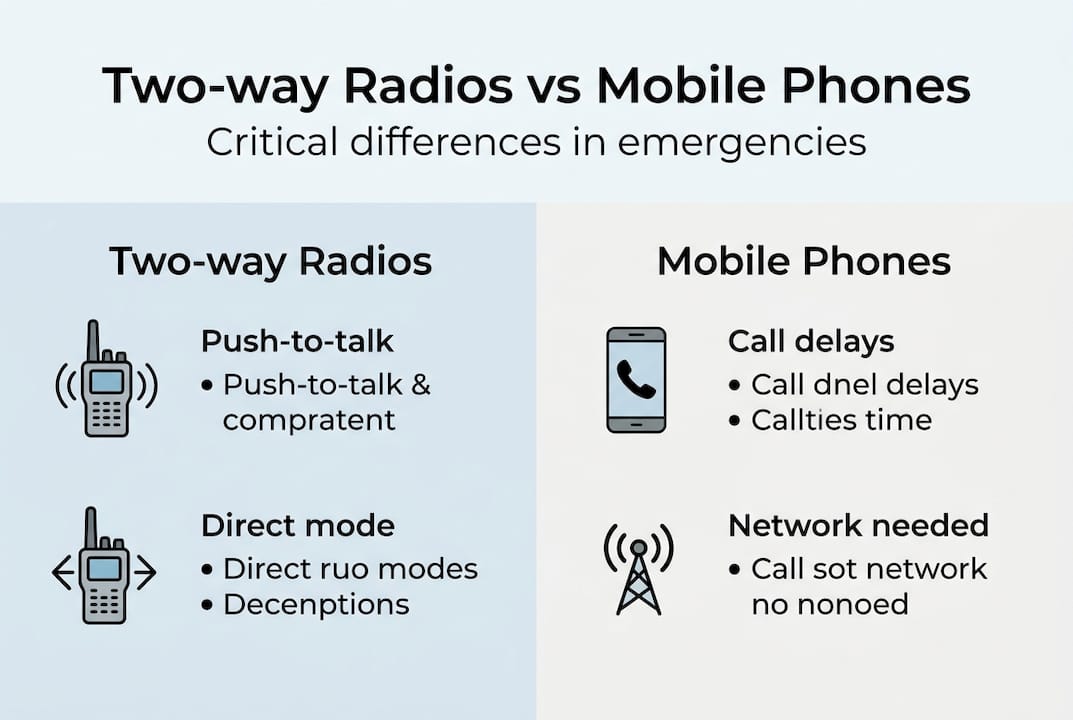
How radios outperform other communication methods
The table below illustrates how two-way radios compare to alternatives in emergency scenarios:
| Feature | Two-way radio | Mobile phone | Satellite phone |
|---|---|---|---|
| Network dependency | None (DMO) | High | Low |
| Call setup time | Under 300ms | Several seconds | 10 to 30 seconds |
| Group calling | Instant | Requires conferencing | Limited |
| Works in power outage | Yes (with battery) | Dependent on towers | Yes |
| Cost per unit | Moderate | High (contracts) | Very high |
When two-way radios become the only reliable option
In particular, there are specific moments when two-way radios are the only viable option:
- During mass emergencies when cellular towers are overloaded
- In areas with poor or no mobile signal coverage
- When coordinating multiple teams across a large site simultaneously
- Following infrastructure damage that takes base stations offline
- In environments where noise levels require dedicated push-to-talk discipline
Understanding professional radio uses across sectors reinforces why so many organisations treat two-way radios as a non-negotiable asset.
How two-way radios ensure resilience during disasters
With that in mind, having established what makes two-way radios uniquely valuable, let us look at how they respond under real crisis conditions.
Common failure points and how radios overcome them
The table below maps common failure modes to practical radio mitigation strategies:
| Failure mode | Impact | Radio mitigation strategy |
|---|---|---|
| Power outage | Base station offline | Generators, battery packs, solar chargers |
| Channel congestion | Communication delays | Pre-assigned talk groups, DMO fallback |
| Infrastructure damage | Network collapse | DMO radio-to-radio, portable repeaters |
| Urban range limits | Signal gaps | Strategically placed repeaters |
The role of direct mode operation in real emergencies
Crucially, Direct Mode Operation allows radios to communicate directly without infrastructure, making it a core resilience tool.
Technical features that support emergency coordination
At this point, knowing how radios overcome technical obstacles, it is vital to understand the features that enable rapid communication.
Core features that define emergency-ready radios
- Push-to-talk (PTT): Instant communication
- Group calling: Reach entire teams
- Encryption: Secure communications
- DMO: Network-free operation
- Fast call setup: High-speed coordination
How to apply these features in real operations
Therefore, practical steps for teams include structured talk groups and regular testing.
Best practices for deployment and ongoing preparedness
Technical capability alone is not enough.
- Regular system testing
- Power redundancy planning
- Documented procedures
- Cross-agency exercises
- Equipment audits
A modern perspective: The overlooked essentials most plans miss
Ultimately, resilience is a habit, not a purchase.
How to strengthen your emergency communications strategy
Smye-Rumsby has supported organisations since 1948. Contact us to ensure your systems perform when needed.
Frequently asked questions
What makes two-way radios more reliable?
They operate independently and offer instant communication.
How do radios work during power cuts?
DMO allows direct communication without infrastructure.