

Many security professionals believe mobile phones provide adequate communication for critical situations. This assumption overlooks fundamental limitations that can compromise safety when seconds matter. Two-way radios deliver instant push-to-talk communication, operate independently of cellular networks, and offer durability that mobile phones cannot match.
For UK security teams managing lone workers, coordinating responses, or protecting retail environments, radios provide reliability that mobile technology simply cannot replicate. This guide explores why radios remain essential for professional security operations, examining TETRA technology standards, practical comparisons with mobile phones, and emerging innovations shaping tactical communications.
Table of Contents
- Key takeaways
- Why two-way radios are vital for security communication
- The role of TETRA technology in secure UK security operations
- Comparing radios and mobiles in security environments
- Limitations and emerging innovations in radio security communications
- Enhance your security communications with expert radio solutions
- Frequently asked questions
Key Takeaways
| Point | Details |
|---|---|
| Instant push to talk | Two way radios provide instant communication without dialling delays, ensuring rapid coordination in emergencies. |
| Network independence | Radios operate on dedicated frequencies that remain usable when mobile networks are congested or fail. |
| Lone worker alerts | Lone worker monitoring features automatically alert supervisors when staff fail to check in or trigger emergency buttons. |
| Rugged durability | Ruggedised radios withstand rain dust and impacts far better than consumer mobile phones. |
| TETRA encryption | TETRA radios offer encryption and direct mode operation to maintain secure communications when infrastructure is unavailable. |
Why two-way radios are vital for security communication
Two-way radios provide instant push-to-talk communication that eliminates the delays inherent in mobile phone dialling. Security professionals facing immediate threats need communication that responds in milliseconds, not seconds. When a lone worker encounters danger or a team needs to coordinate rapidly, pressing a single button to reach multiple colleagues simultaneously can prevent incidents from escalating.
Mobile phones depend entirely on cellular networks that become congested during major events or fail completely during infrastructure disruptions. Radios operate on dedicated frequencies that remain functional when mobile networks collapse under demand. During the 2011 London riots, mobile networks struggled whilst radio systems maintained reliable communications for security teams. This independence from commercial infrastructure makes radios indispensable for critical security operations.
Lone worker monitoring features built into modern radio systems automatically alert supervisors when staff members fail to check in or trigger emergency buttons. These capabilities provide essential protection for security personnel working isolated shifts in warehouses, construction sites, or patrol routes. Mobile phones lack the dedicated emergency signalling that radios integrate as standard safety features.
Shopwatch schemes using digital radios have delivered measurable results across UK retail environments. Brighton’s scheme reported significant reductions in shoplifting incidents after implementing coordinated radio communications between stores and security teams. Manchester retailers experienced similar improvements, with faster response times deterring repeat offenders. The ability to broadcast suspect descriptions instantly to multiple locations creates a protective network that mobile phones cannot replicate efficiently.
Radios withstand harsh treatment that would destroy consumer mobile phones within weeks. Security professionals working outdoors face rain, dust, and physical impacts that demand ruggedised equipment. Professional radios meet military specifications for durability, with battery life extending 12 to 18 hours under continuous use. Mobile phones typically require charging after 6 to 8 hours of heavy security work, creating operational gaps that compromise safety.
Pro Tip: Implement regular radio equipment safety tips including battery rotation schedules and waterproof accessory checks to maximise reliability during critical operations.
“Radios deliver group communication capabilities that mobile phones fundamentally cannot match. Broadcasting urgent information to an entire security team simultaneously creates response coordination that individual phone calls never achieve.”
The role of TETRA technology in secure UK security operations
TETRA radios offer encryption and direct mode operation that address coverage gaps through device-to-device communication when infrastructure fails. This European standard dominates UK emergency services because it provides end-to-end encryption protecting sensitive operational communications from interception. Security professionals handling confidential information require this level of protection that consumer mobile networks cannot guarantee.
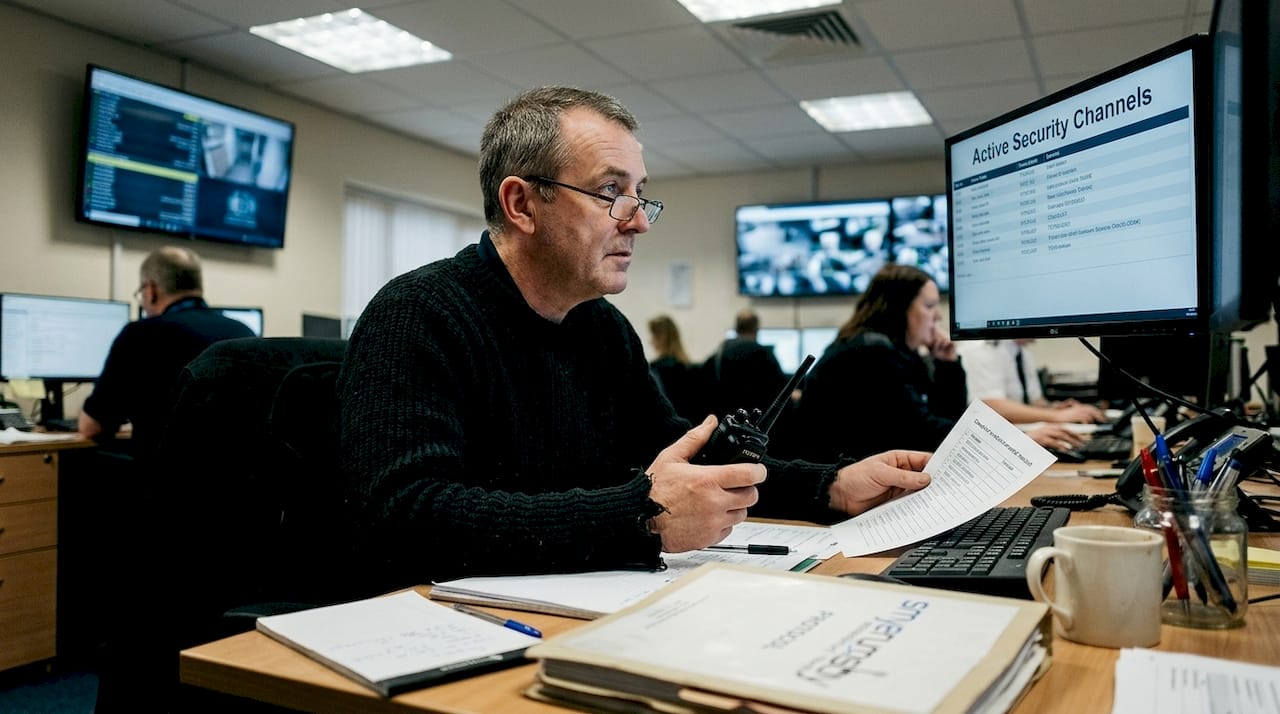
Call setup times under 300 milliseconds enable TETRA systems to establish connections nearly instantaneously. This responsiveness proves critical when security teams coordinate responses to unfolding incidents. Compare this to mobile phone call establishment that requires several seconds of network negotiation, and the tactical advantage becomes clear. Every millisecond counts when preventing security breaches or protecting vulnerable individuals.
Trunked radio systems allow multiple security organisations to share spectrum efficiently through dynamic channel allocation. Rather than dedicating fixed frequencies to single users, trunking assigns channels on demand as conversations occur.
This efficiency enables more organisations to operate within limited radio spectrum whilst maintaining reliable communications. British emergency services rely on this technology to coordinate across police, ambulance, and fire services during major incidents.
| TETRA feature | Security benefit | Typical performance |
|---|---|---|
| End-to-end encryption | Protects sensitive communications | 256-bit security standard |
| Direct mode operation | Maintains contact during infrastructure failure | 5km range device-to-device |
| Fast call setup | Enables instant emergency response | Under 300 milliseconds |
| Group calls | Coordinates teams simultaneously | Up to 999 members per group |
| Priority access | Ensures critical calls connect first | Supervisor override capability |
British emergency services depend on TETRA for secure group communications that coordinate complex multi-agency responses. The Airwave network serving UK police, ambulance, and fire services represents Europe’s largest TETRA deployment, supporting over 300,000 users. Security professionals working alongside emergency services benefit from interoperable communications that integrate seamlessly during major incidents requiring coordinated responses.
Ongoing developments address emerging threats including quantum computing risks to current encryption standards. TETRA Association members are developing post-quantum cryptography to future-proof secure communications against advanced decryption capabilities. Security organisations investing in TETRA technology gain access to evolving standards that maintain protection as threats develop.
Pro Tip: Explore two-way radio examples from similar security environments to identify TETRA features that match your operational requirements and threat profile.
Comparing radios and mobiles in security environments
Radios outperform mobiles with instant group communications that eliminate time-consuming individual phone calls. Security teams managing large venues or distributed sites need to broadcast information simultaneously to all personnel. Radios achieve this with a single button press, whilst mobile phones would require multiple calls or rely on consumer messaging apps that lack professional reliability and security.
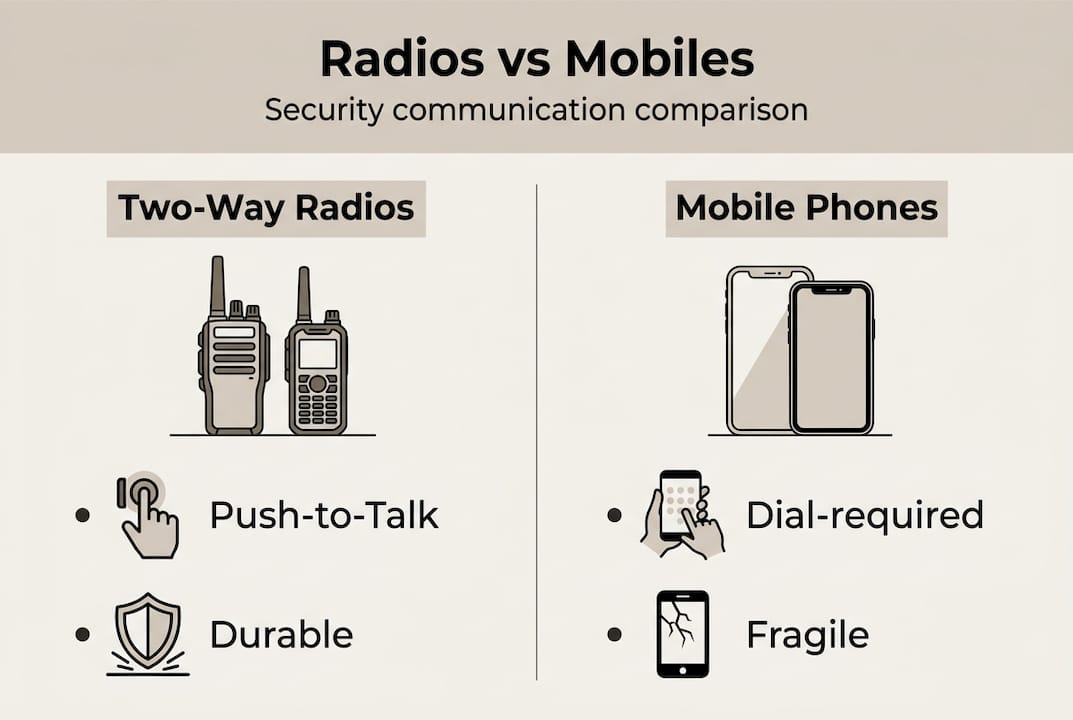
Durability standards separate professional radios from consumer mobile devices fundamentally. Security professionals drop equipment, work in rain, and operate in dusty environments that would void mobile phone warranties immediately. Radios meeting IP67 or IP68 ratings survive water immersion and dust exposure that destroys mobile phones. This ruggedisation translates directly to lower replacement costs and reliable communications during adverse conditions.
Network independence means radios function in underground car parks, remote perimeters, and during infrastructure failures that leave mobile phones useless. Security operations cannot depend on commercial networks that prioritise consumer traffic over professional communications. Radios operating on dedicated frequencies maintain connectivity regardless of public network congestion or coverage gaps.
| Feature | Two-way radios | Mobile phones |
|---|---|---|
| Communication speed | Instant push-to-talk | Dial and wait for connection |
| Network dependency | Independent dedicated frequencies | Requires cellular coverage |
| Battery life (heavy use) | 12-18 hours typical | 6-8 hours typical |
| Durability rating | IP67/IP68 standard | Consumer grade, easily damaged |
| Group calling | Native broadcast capability | Requires apps or conference setup |
| Emergency features | Dedicated panic buttons, lone worker monitoring | Standard mobile features only |
| Encryption | Professional end-to-end options | Consumer network security |
Mobile phone battery life degrades rapidly under security work patterns involving constant communication, GPS tracking, and camera use. Security professionals starting 12-hour shifts cannot rely on devices requiring mid-shift charging. Radios designed for professional use deliver full-shift battery performance with spare batteries providing seamless continuity.
Group calling efficiency creates operational advantages that mobile technology cannot replicate practically. Broadcasting a suspect description to 20 security personnel takes seconds with radios but would require 20 individual mobile calls or depend on messaging apps that lack instant notification guarantees. This efficiency gap widens dramatically as team sizes increase.
“The fundamental difference lies in design philosophy. Radios are purpose-built for professional communications where reliability, speed, and coordination determine operational success. Mobile phones serve consumer convenience, not critical security requirements.”
Pro Tip: Review how radios improve workplace safety through features specifically designed for security and emergency response that mobile phones lack.
Limitations and emerging innovations in radio security communications
Power outages can disrupt radios reliant on network infrastructure, creating vulnerabilities during disasters that damage electrical systems. Whilst handheld radios operate on batteries, repeater stations and base stations require mains power or backup generators. Security operations must plan redundancy through battery backup systems and alternative communication methods when infrastructure fails.
Channel switching issues have led to missed calls in policing operations, highlighting technical limitations that require operational awareness. Metropolitan Police officers reported incidents where radio systems failed to notify them of incoming calls when switching between channels. These failures demonstrate that even sophisticated systems have weaknesses requiring backup protocols and regular testing.
Recent encryption vulnerabilities discovered in legacy radio systems require evolving security protocols to maintain confidentiality. Researchers demonstrated theoretical attacks against older encryption standards, prompting upgrades across UK emergency services. Security organisations using radio communications must stay informed about encryption standards and implement updates as manufacturers release improvements.
Advanced innovations address these limitations whilst expanding tactical capabilities:
- DarkSky antenna technology reduces RF footprint by 90% compared to traditional systems, making tactical operations harder to detect through radio frequency monitoring
- STICS standards promote modular, interoperable radio systems allowing UK defence and security organisations to integrate equipment from multiple manufacturers seamlessly
- Quantum-resistant encryption development prepares radio communications for future threats from advanced computing capabilities
- Artificial intelligence integration enables automatic threat detection through voice pattern analysis and anomaly identification
- Satellite backup systems provide communications continuity when terrestrial infrastructure fails completely
Professional security operations require contingency planning that acknowledges radio limitations:
- Establish backup communication protocols using multiple technologies including radios, mobile phones, and satellite systems
- Implement regular testing schedules that verify radio performance under realistic operational conditions
- Train personnel on troubleshooting common radio issues including interference, coverage gaps, and equipment failures
- Maintain spare equipment stocks including batteries, antennas, and complete backup radios for critical roles
- Monitor manufacturer security bulletins and apply encryption updates promptly to address emerging vulnerabilities
DarkSky technology represents significant advancement for security operations requiring covert communications. Traditional radio systems broadcast signals detectable by sophisticated monitoring equipment, potentially compromising tactical operations. By reducing the RF signature dramatically, DarkSky-enabled radios maintain communications whilst minimising detection risks.
Pro Tip: Consider how radio use in events demonstrates practical approaches to managing radio limitations through proper planning, backup systems, and trained personnel.
Enhance your security communications with expert radio solutions
Smye-Rumsby provides specialist guidance on hiring two-way radios versus purchasing equipment to optimise costs whilst ensuring reliable communications. Security operations with fluctuating staffing levels or temporary projects benefit from flexible hire arrangements that eliminate capital expenditure whilst maintaining professional-grade equipment. Permanent teams gain long-term value through ownership, with maintenance contracts ensuring ongoing reliability.
Robust models like the Motorola R2 radios deliver durability and performance specifically designed for security professionals working in demanding environments. These devices meet rigorous standards for water resistance, drop protection, and battery life that match the realities of security work. Selecting equipment that withstands operational conditions prevents costly replacements and maintains team communications during critical incidents.
Practical radio use case studies help security managers identify solutions matching their specific operational requirements. Learning from similar organisations’ experiences accelerates implementation whilst avoiding common pitfalls. Expert consultation ensures radio systems integrate effectively with existing security protocols and deliver measurable improvements in response coordination and team safety.
Frequently asked questions
What is the main advantage of radios over mobile phones in security?
Radios provide instant push-to-talk communication that eliminates dialling delays, enabling security teams to respond within milliseconds rather than seconds. They operate independently of cellular networks that become congested or fail during critical incidents. This reliability combined with group calling capabilities makes radios essential for coordinating security responses effectively.
How do shopwatch schemes benefit from two-way radios?
Shopwatch schemes with digital radios enable retailers to broadcast suspect descriptions instantly across multiple stores, creating coordinated responses that deter theft. Brighton and Manchester reported measurable reductions in shoplifting after implementing radio-coordinated schemes. The faster communication between security personnel and store staff prevents repeat offences whilst improving evidence gathering. Discover how crime reduction in shopping centres relies on coordinated radio communications.
What are the risks and limitations of radio communications in security?
Radio failures during power outages can disrupt communications when infrastructure loses electrical supply, requiring backup power systems. Encryption flaws discovered in legacy systems have prompted security updates across UK emergency services. Channel switching issues have caused missed calls in operational settings, highlighting the need for backup protocols and regular system testing to maintain reliability.
Why do UK emergency services rely on TETRA technology?
TETRA provides end-to-end encryption protecting sensitive operational communications from interception, essential for confidential police and security work. Fast call setup under 300 milliseconds enables instant emergency coordination. The technology supports group calls allowing simultaneous communication with entire teams, whilst trunked systems share spectrum efficiently across multiple organisations. Direct mode operation maintains device-to-device communications when infrastructure fails completely.
How long do radio batteries last compared to mobile phones during security shifts?
Professional radios typically deliver 12 to 18 hours of battery life under continuous security use, covering full shifts without charging. Mobile phones under similar heavy use patterns require charging after 6 to 8 hours, creating operational gaps. Radios designed for professional applications prioritise battery performance, with hot-swappable batteries enabling continuous operation across multiple shifts without communication interruptions.