

Construction sites are among the noisiest working environments in the UK, with noise levels exceeding 85 dB routinely recorded across active zones. At that level, shouting is ineffective and mobile phones become unreliable, leaving teams without a dependable way to coordinate or respond to emergencies. Two-way radio systems resolve this directly, providing instant, clear communication regardless of background noise. For construction project managers and safety officers, understanding why radios are the right tool is not just about convenience. It is about meeting legal obligations, protecting workers, and keeping projects on schedule.
Table of Contents
- The importance of reliable communication on construction sites
- How radio systems address high-noise and fast-moving site conditions
- Site safety, compliance and operational gains with radios
- Expert tips: Maximising reliability and accountability with radio systems
- Find the best radio solution for your site
- Frequently asked questions
Key Takeaways
| Point | Details |
|---|---|
| Radios thrive in noisy sites | Radio systems deliver clear, instant communication where phones and shouting fail due to excessive noise. |
| Essential for HSE compliance | HSE guidelines require effective site communication and radios help meet these legal standards. |
| Boosts safety and efficiency | Using radios enhances emergency response, reduces accident risk, and streamlines project operations. |
| Expert maintenance tips | Training users and maintaining equipment ensures reliability and accountability on every project. |
The importance of reliable communication on construction sites
Communication on a construction site is not optional. It is a safety-critical function that the Health and Safety Executive takes seriously. HSE guidelines require effective communication as part of any robust site safety management system, and failing to provide it can expose organisations to enforcement action, fines, or worse.
When communication breaks down, the consequences are immediate and sometimes severe. A delayed instruction during a crane lift, a missed warning before a controlled demolition, or a slow emergency response can all result in serious injury. These are not hypothetical scenarios. They are the kinds of incidents that HSE investigations regularly uncover.
Two-way radios address these risks directly. Unlike mobile phones, they do not depend on network coverage, do not require unlocking or dialling, and can reach multiple team members simultaneously. Understanding radio safety in workplaces helps site managers appreciate just how significant this difference is in practice.
Key reasons why radios outperform alternatives on site include:
- Instant push-to-talk access with no dialling or network dependency
- Group communication across multiple channels and teams simultaneously
- Durability suited to outdoor, dusty, and wet site conditions
- Longer battery life compared to smartphones under heavy use
- Compliance support aligned with HSE communication guidelines
“Effective communication is fundamental to safe working. Where communication fails, the risk of accidents and incidents increases significantly.” This principle underpins every HSE inspection of construction sites across the UK.
Reviewing radio equipment safety tips before deploying a system ensures your team gets the most from their equipment from day one.
How radio systems address high-noise and fast-moving site conditions
Construction sites are dynamic environments. Teams move between zones, machinery operates continuously, and conditions change rapidly throughout the working day. A communication tool that works in an office simply will not perform adequately here.
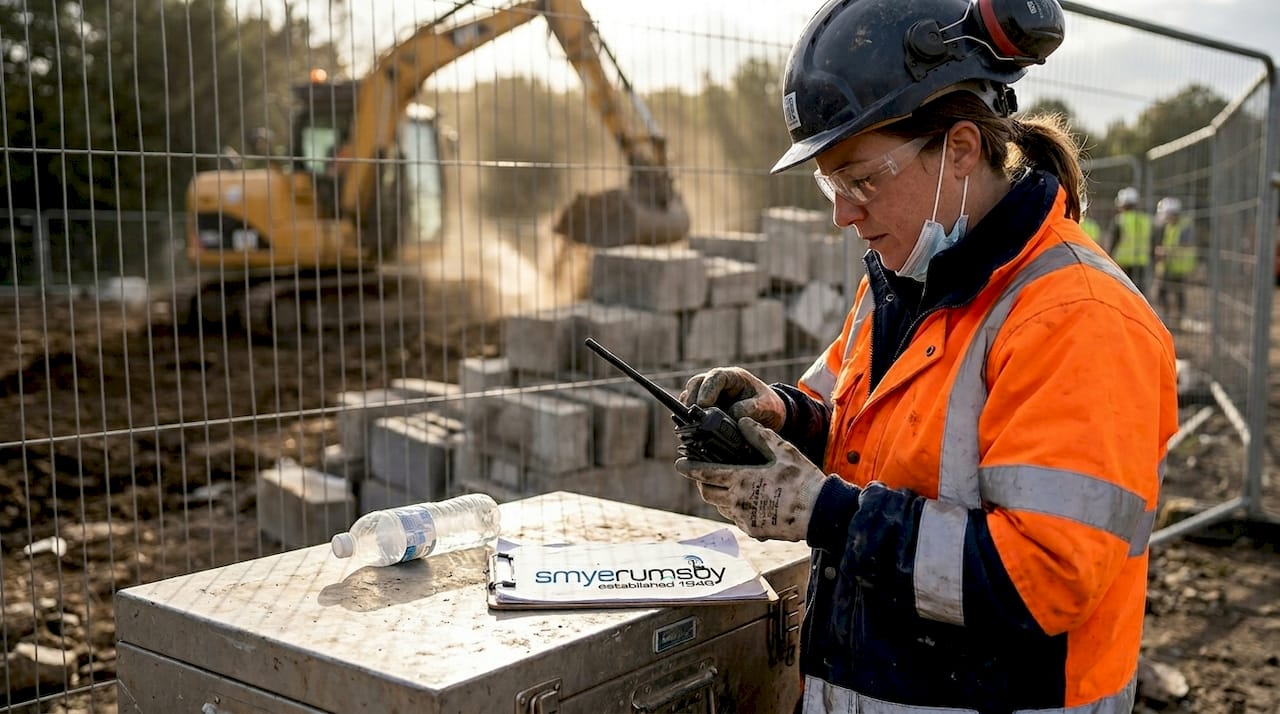
Modern two-way radios are engineered specifically for these conditions. Noise-cancelling microphones filter out background sound, ensuring the speaker’s voice is transmitted clearly even when noise exceeds 85 dB. Speaker wattage on professional-grade radios is significantly higher than on smartphones, meaning messages are audible even in loud environments without the need to hold the device close to the ear.
The comparison below illustrates the practical differences between radios and mobile phones on a typical construction site:
| Feature | Two-way radio | Mobile phone |
|---|---|---|
| Network dependency | None | Requires signal |
| Response time | Instant push-to-talk | Dial and wait |
| Group communication | Yes, multiple channels | Conference call only |
| Noise-cancelling mic | Standard on most models | Limited on most devices |
| Durability rating | IP67 or higher common | Varies, often lower |
| Battery life under use | 12 to 16 hours typical | 4 to 8 hours typical |
Push-to-talk functionality is particularly valuable on fast-moving sites. A single button press connects a site manager to an entire team in under a second. There is no delay, no confusion, and no missed call. Exploring push-to-talk radio hire options allows project managers to trial this capability before committing to a full purchase.
Pro Tip: Before starting a new project phase, walk the entire site with a radio and test signal quality in every zone, including basements, stairwells, and areas behind heavy machinery. Identify any dead spots early and address them with repeaters or additional units.
For a broader view of how radios are used across different professional settings, practical radio uses for professionals provides useful context that translates well to construction environments.
Site safety, compliance and operational gains with radios
Once a radio system is in place, the benefits extend well beyond basic communication. The operational and compliance gains are measurable and directly relevant to how a site is managed day to day.
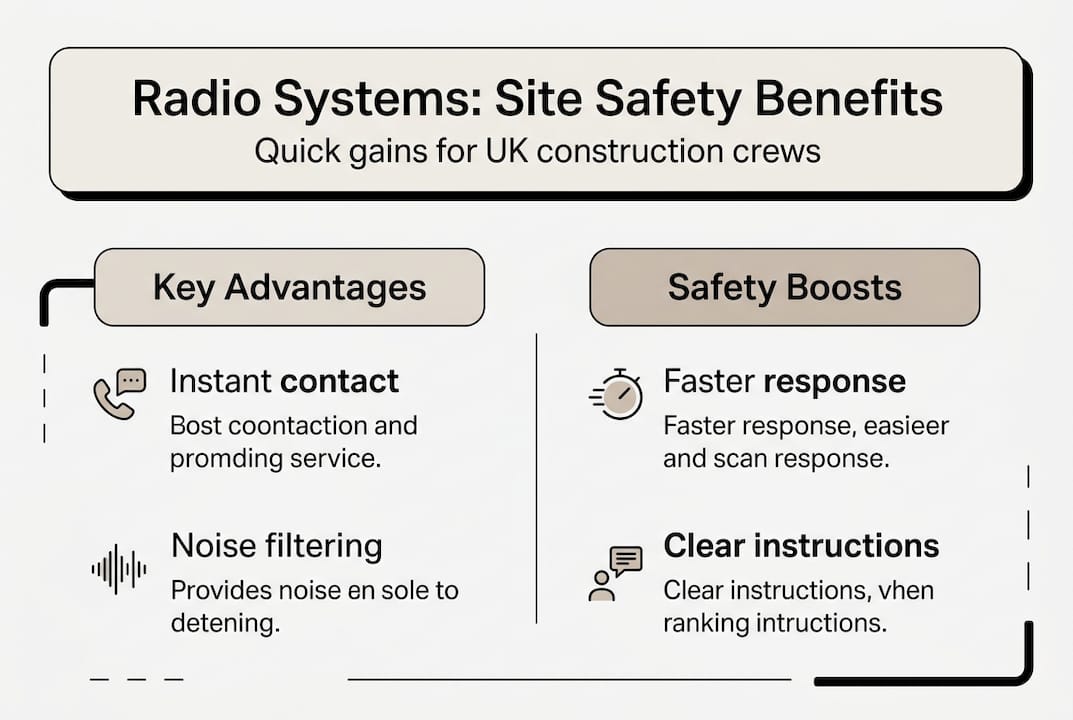
From a safety perspective, radios significantly improve emergency response times. When an incident occurs, the ability to alert all relevant personnel instantly, coordinate evacuation, and contact emergency services without delay can be the difference between a controlled response and a chaotic one. HSE noise risk guidelines reinforce the need for communication systems that function reliably in exactly these conditions.
The operational gains are equally compelling. Consider the following sequence of improvements that a well-implemented radio system supports:
- Faster instruction delivery reduces waiting time between task completion and the next assignment
- Real-time coordination between groundworkers, crane operators, and site managers prevents costly errors
- Immediate incident reporting allows supervisors to document events accurately as they happen
- Reduced downtime as teams spend less time searching for colleagues or waiting for callbacks
- Improved accountability through logged communications and structured channel use
From a compliance standpoint, HSE guidelines on communication make clear that push-to-talk communication is essential for safety-critical tasks. Radios provide documented, reliable evidence that your site meets this standard.
“Organisations that invest in reliable communication infrastructure consistently report fewer near-misses and faster emergency response times compared to those relying on informal methods.”
For sites requiring a full review of their communication setup, the emergency radio equipment checklist is a practical starting point. A real-world example of how a professional radio installation supports site operations can be found in the radio installation at Dover Castle case study, which demonstrates the planning and execution involved in a demanding environment.
| Benefit area | Without radios | With radios |
|---|---|---|
| Emergency response | Delayed, reliant on phones | Instant, site-wide alert |
| Instruction delivery | Slow, prone to error | Real-time, clear |
| Incident documentation | Retrospective, incomplete | Immediate, accurate |
| Compliance evidence | Difficult to demonstrate | Supported by system logs |
Expert tips: Maximising reliability and accountability with radio systems
Owning or hiring a radio system is only the first step. Getting consistent, reliable performance from it requires deliberate effort from site managers and safety officers alike.
Training is the foundation. Every user should understand basic radio protocols, including how to identify themselves, how to keep transmissions brief and clear, and how to use emergency channels correctly. Combining radios with body cameras adds a further layer of accountability, providing visual evidence to complement audio records when incidents are reviewed.
Maintenance is equally important and often overlooked. Radios used on construction sites are exposed to dust, moisture, vibration, and impact. A structured radio maintenance workflow keeps equipment performing at its best and reduces the risk of failure at a critical moment.
Key maintenance and operational best practices include:
- Clean radios regularly, paying attention to speaker grilles and charging contacts where dirt accumulates
- Inspect for physical damage after any drop or impact, even if the radio appears to function normally
- Test battery performance at the start of each week and replace ageing cells before they fail mid-shift
- Conduct a full coverage test at the start of each new project phase to identify any signal gaps
- Review channel assignments when site layout changes to ensure teams remain on the correct frequencies
- Log faults promptly so that repairs are scheduled before minor issues become operational problems
Pro Tip: Pair each radio with a named user at the start of every shift. This simple step improves accountability, makes it easier to trace communication gaps, and encourages users to treat equipment with greater care.
Integrating radios with body-worn cameras is a growing practice on UK construction sites. Body cameras improve accountability by capturing footage that supports incident investigations, insurance claims, and HSE reporting. When used alongside radios, they create a comprehensive record of site activity that protects both workers and organisations.
Find the best radio solution for your site
At Smye-Rumsby, we have supported construction teams across the South East of England since 1948, providing professional-grade radio systems from trusted manufacturers including Motorola and Kenwood. Whether you are managing a short-term project or a long-running development, we offer flexible options to match your requirements and budget. Understanding whether to hire or purchase radios is often the first practical decision, and our team can guide you through the considerations. For sector-specific guidance, our resource on the best radios for construction covers the models and configurations most suited to site environments. We also provide installation, maintenance, and access to emergency radio equipment to ensure your site is fully prepared. Contact us to discuss your communication needs.
Frequently asked questions
What makes radio systems safer than mobile phones on noisy sites?
Radios use noise-cancelling technology and high-wattage speakers, ensuring clear communication in environments exceeding 85 dB where phones and shouting are unreliable. They also require no network signal and connect instantly at the press of a button.
Does using radios help with HSE compliance?
Yes. HSE guidelines require effective communication for safety-critical tasks, and two-way radios meet this requirement by providing instant, reliable contact across all site zones.
Are there tips for keeping radio systems dependable on site?
Train all staff on radio protocols, clean and inspect equipment regularly, and test site coverage before each new project phase to ensure reliable performance in all conditions.
Can radios be integrated with other site safety technology?
Yes. Radios can be used alongside body cameras and alarms to improve site accountability, support incident investigations, and enable faster emergency responses.