
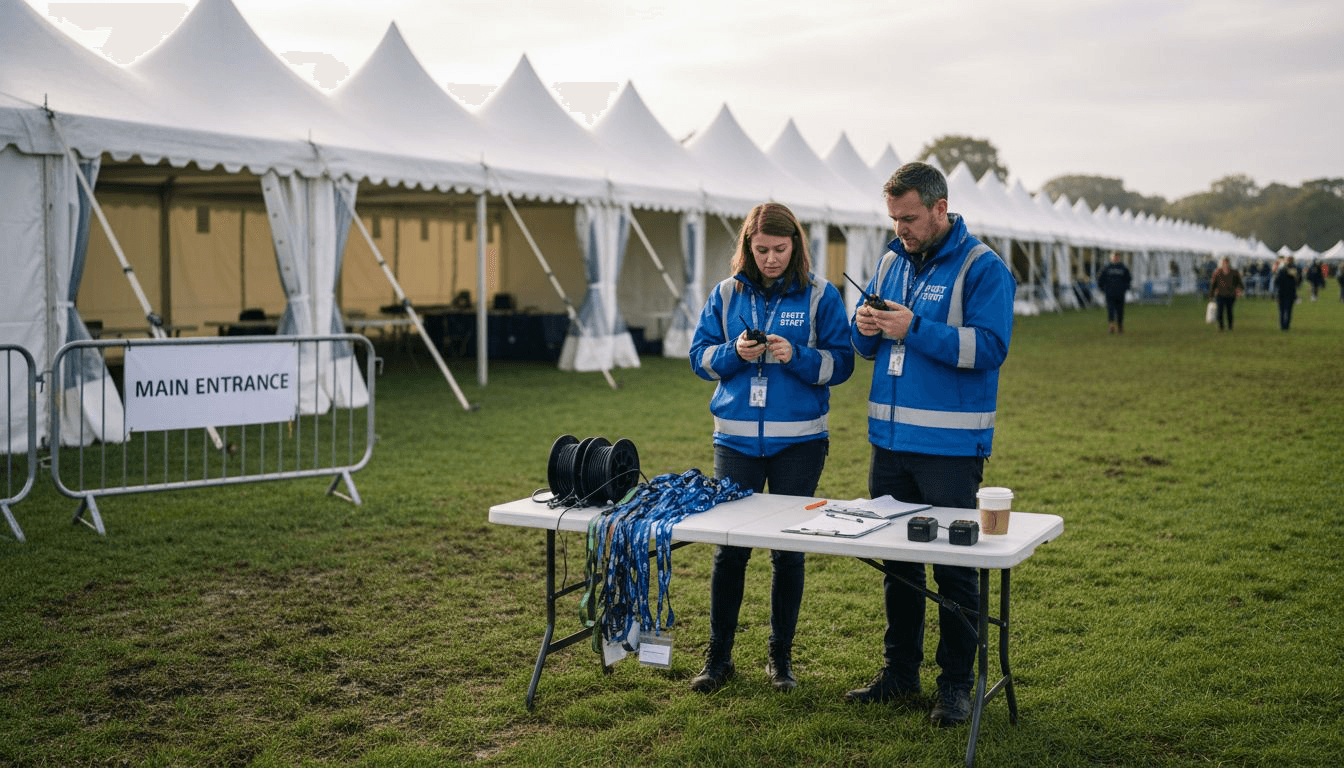
Many UK event planners experience communication disruptions because they underestimate radio requirements by 15%, risking coordination failures during critical moments. Whether you’re managing a festival, conference, or outdoor celebration, reliable two-way radios keep your team connected across sprawling venues. This guide helps you assess needs accurately, select appropriate equipment, rent efficiently, and maintain communication reliability throughout your event.
Table of Contents
- Understanding Two-Way Radio Rental For Events
- Prerequisites And Planning Before Renting
- Choosing The Right Equipment And Technology
- Step-By-Step Two-Way Radio Rental Process
- Operational Best Practices And Troubleshooting
- Common Mistakes To Avoid In Two-Way Radio Rental
- Expected Outcomes And Measuring Success
- Discover Expert Two-Way Radio Rental Solutions
- Frequently Asked Questions
Key takeaways
| Point | Details |
|---|---|
| Planning prevents failures | Proper assessment of radio quantities and coverage areas eliminates costly communication gaps during events. |
| Digital offers advantages | Digital radios deliver clearer sound, longer battery life, and advanced features compared to analogue alternatives. |
| Testing is non-negotiable | On-site equipment testing and thorough staff training before event day reduce communication failures significantly. |
| Choose transparent providers | Select rental companies with clear contracts, no hidden fees, and responsive technical support for peace of mind. |
| Maintain contingencies | Keep spare radios and batteries readily available to handle unexpected equipment issues without disrupting operations. |
Understanding two-way radio rental for events
Two-way radios serve as the communication backbone for large UK events, enabling instant coordination between security teams, logistics staff, medical personnel, and management across vast venues. Radio communication in event management proves essential when mobile networks become congested or unreliable with thousands of attendees.
Event organisers typically choose between analogue and digital radio systems, each offering distinct capabilities. Analogue radios provide straightforward push-to-talk functionality at lower costs, whilst digital systems deliver enhanced features like GPS tracking, text messaging, and superior audio clarity even in noisy environments.
Renting makes practical sense for most event planners because it eliminates upfront capital costs, provides access to the latest technology, and includes maintenance support. You avoid storing equipment between events and can scale quantities up or down based on specific event requirements. Professional two-way radio hire for events also includes licensing assistance, technical support during your event, and flexible rental periods matching your exact timeline.
Key scenarios where rental proves advantageous:
- One-off or seasonal events without ongoing communication needs
- Testing different radio technologies before committing to purchase
- Supplementing existing equipment for larger-than-usual events
- Accessing premium digital radios without substantial investment
- Ensuring latest models with manufacturer warranties and support
Prerequisites and planning before renting
Successful radio deployment begins with accurate needs assessment weeks before your event. Start by mapping your venue layout and identifying all areas requiring coverage, including backstage zones, car parks, entrances, and emergency assembly points.
Estimate radio quantities by assigning one unit per staff member with coordination responsibilities, then add 10 to 15 percent spares for contingencies. A festival with 50 core staff typically needs 55 to 58 radios to ensure coverage during battery swaps or equipment issues.
Verify Ofcom frequency licensing requirements early in your planning process. In the UK, obtaining proper frequency licensing through Ofcom is mandatory for two-way radio use unless you opt for specific licence-free two-way radios with limited range and power. Rental providers often handle licensing on your behalf, but confirm this service during initial discussions.
Budget realistically by accounting for:
- Daily or weekly rental rates per unit
- Security deposits are refundable after equipment return
- Delivery and collection charges for your venue
- Optional accessories like spare batteries or headsets
- Contingency funds for potential damage or loss
Define clear communication protocols specifying which channels serve different purposes, standardised terminology for common situations, and escalation procedures for emergencies. Assign radio distribution responsibilities to specific team members who’ll track equipment throughout your event.
Pro Tip: Create a simple spreadsheet listing every radio’s serial number, assigned user, and return condition to streamline checkout and return processes whilst protecting against disputed damage charges.
Choosing the right equipment and technology
Digital and analogue radios differ fundamentally in how they transmit voice signals, impacting clarity, features, and costs. Analogue radios convert voice into continuous radio waves, making them straightforward but susceptible to interference and static. Digital radios encode voice into binary data packets, enabling error correction and cleaner audio quality.
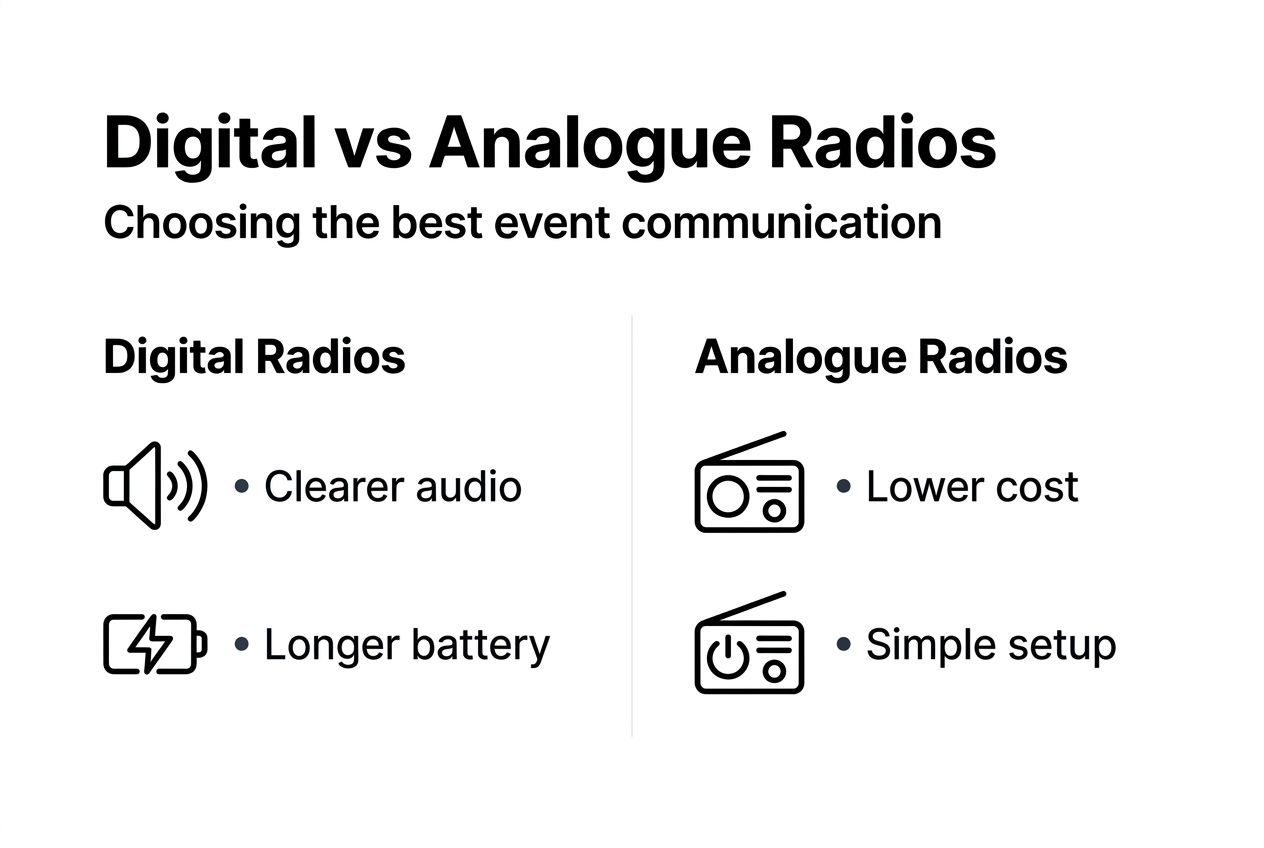
Digital radios reduce background noise by 40% and offer 30 percent longer battery life compared to analogue alternatives. These advantages prove crucial for multi-day festivals or large outdoor events where environmental noise and extended operational hours challenge communication reliability.
Consider digital radios when your event involves:
- Multi-day operations requiring extended battery performance
- Large outdoor venues with potential interference sources
- Complex coordination needing GPS tracking or text messaging
- Professional broadcast quality audio for VIP communications
- Integration with dispatch systems or control room software
Analogue radios remain cost-effective for single-day events with straightforward communication needs and smaller budgets. They’re reliable, familiar to most users, and sufficient when advanced features aren’t necessary.
| Feature | Digital Radios | Analogue Radios |
|---|---|---|
| Audio clarity | Excellent, noise-cancelled | Good, some static |
| Battery life | 30% longer duration | Standard duration |
| Range | Superior penetration | Adequate for most |
| Features | GPS, text, encryption | Basic voice only |
| Cost | Higher rental rates | Lower rental rates |
| Licensing | Ofcom required | Ofcom required |
Evaluate additional features matching your operational requirements. GPS tracking helps locate wandering staff across sprawling venues. Text messaging enables silent communication in noise-sensitive areas. Voice encryption protects confidential security discussions. Emergency alert buttons provide instant distress signalling.
Battery endurance matters significantly for events lasting more than 8 hours. Request high-capacity batteries or additional charged spares to maintain communications throughout extended operations without interruption.
Pro Tip: Radio solutions for mixed fleets allow combining digital and analogue radios when budget constraints prevent full digital deployment, though this requires compatible gateway technology.
Step-by-step two-way radio rental process
Research rental providers with demonstrated event experience and positive client testimonials. Request quotes from three to four companies, comparing not just prices but also equipment quality, support services, and contract terms.
Choosing two-way radio rental providers requires scrutinising several factors beyond headline rates. Verify the provider stocks current model radios from reputable manufacturers like Motorola or Kenwood. Confirm they offer on-site technical support during your event if issues arise.
Follow this rental sequence:
- Contact providers six to eight weeks before your event with detailed requirements
- Request formal quotes including all fees, deposit amounts, and contract terms
- Compare total costs and review cancellation policies carefully
- Book equipment, confirming delivery and collection dates and times
- Arrange a pre-event testing session at your venue if possible
- Inspect all equipment upon delivery, noting any existing damage
- Test radios immediately to verify functionality before signing acceptance
- Distribute radios to staff with clear usage instructions and protocols
- Collect and inspect equipment after your event before the provider collection
- Document return condition with photographs to prevent disputed charges
Understand contract terms thoroughly, particularly:
- Exact rental period and overtime charges for late returns
- Security deposit amounts and refund timelines
- Damage liability thresholds and insurance options
- Support availability, including emergency contact numbers
- Replacement procedures if equipment fails during your event
Inspect every radio, battery, charger, and accessory upon delivery. Test each unit’s transmission and reception quality. Check battery charge levels and verify chargers function correctly. Document any scratches, dents, or operational issues immediately to avoid liability for pre-existing damage.
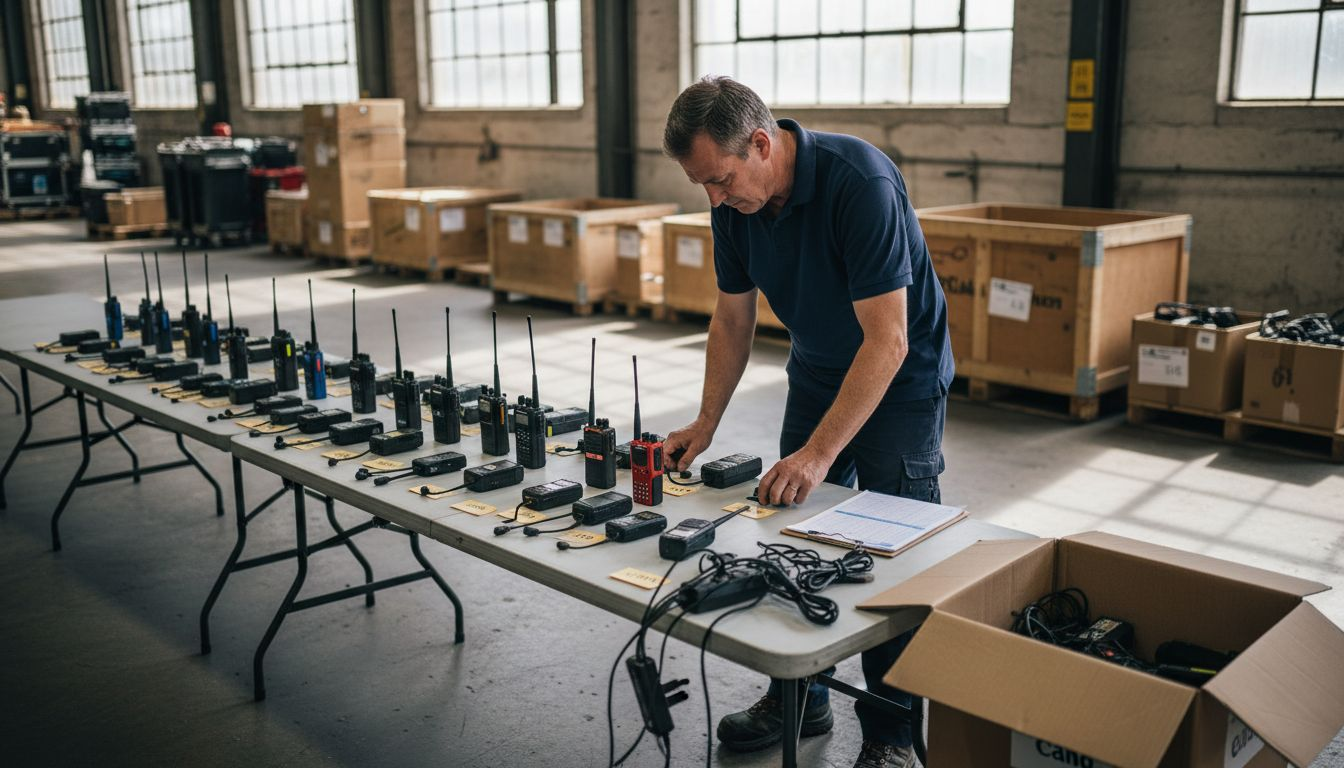
Coordinate delivery timing to allow equipment familiarisation before your event, whilst avoiding extended rental charges. Most providers offer flexible collection immediately after events or the following business day. Understanding hire versus purchase comparison helps evaluate whether rental remains the best long-term strategy for recurring events.
Operational best practices and troubleshooting
Thorough staff training prevents most operational issues and maximises radio effectiveness. Regular pre-event testing and staff training reduce communication failures by 18 percent, demonstrating how preparation directly impacts reliability.
Conduct hands-on training sessions covering:
- Proper radio power-on and channel selection procedures
- Push-to-talk button operation and correct holding positions
- Volume adjustment and audio clarity optimisation techniques
- Battery conservation practices for extended operations
- Emergency protocols and priority communication procedures
Schedule comprehensive on-site testing the day before your event opens. Walk your entire venue whilst transmitting and receiving on all assigned channels. Identify dead zones requiring additional radios or repeater stations. Verify radios communicate clearly from your furthest operational points.
Maintain batteries and equipment throughout multi-day events. Establish a charging station with organised labelling systems, preventing mixed-up units. Rotate batteries systematically so no user experiences mid-shift power loss. Clean antennas and exterior surfaces regularly to maintain optimal performance.
Keep spare radios and fully charged batteries accessible at your command centre for immediate deployment. When a unit fails or a battery depletes unexpectedly, quick swaps prevent communication gaps, disrupting operations.
Common issues and immediate fixes:
- Weak signal or static: Replace antenna, move to higher ground, or switch channels
- Battery draining quickly: Reduce volume, disable unnecessary features, and swap the battery immediately
- Unable to transmit: Check channel selection, verify push-to-talk button function, restart radio
- Receiving interference: Change to alternative channel, verify correct frequency programming
- Radio won’t power on: Check battery insertion, clean contacts, try different battery
Pro Tip: Designate one technically confident team member as your radio coordinator responsible for troubleshooting, managing spares, and serving as provider liaison if professional support becomes necessary.
Explore two-way radio hire and push to talk radio hire options that include technical support packages providing expert assistance throughout your event duration.
Common mistakes to avoid in two-way radio rental
Communication failures occur in 15 to 18% of events due to underestimated radios and skipped testing, making awareness of common mistakes essential for prevention.
Underestimating quantity needs creates frustrating coverage gaps when staff must share radios or coordinate without direct communication. Calculate requirements generously, remembering that multiple zones, shifts, and contingencies all demand additional units beyond your immediate headcount.
Ignoring Ofcom licensing exposes your event to interference from other radio users and potential legal consequences. The UK strictly regulates radio frequencies to prevent conflicts. Confirm your rental provider includes proper licensing or handles this compliance requirement explicitly.
Failing to test equipment before your event opens invites avoidable disasters. Dead batteries, faulty units, and incorrect programming only surface when operations begin, leaving you scrambling whilst attendees arrive. Allocate time for thorough pre-event testing regardless of schedule pressures.
Neglecting maintenance and contingency planning increases downtime when inevitable technical issues arise. Without spare batteries, backup radios, or basic troubleshooting knowledge, minor problems cascade into major communication breakdowns affecting event safety and coordination.
Successful event communication relies on redundancy at every level. Plan for equipment failures, battery depletion, and user errors by maintaining spares and training backup operators who can step in immediately.
Additional mistakes undermining radio effectiveness:
- Selecting cheapest provider without verifying equipment quality or support services
- Overlooking accessories like earpieces reducing audio clarity in noisy environments
- Distributing radios without training leading to user confusion and misuse
- Failing to establish clear channel assignments causing communication chaos
- Returning equipment without documentation enabling disputed damage claims
Consult expert two-way radio advice when planning your first large event or scaling to significantly larger operations requiring professional guidance and proven equipment solutions.
Expected outcomes and measuring success
Properly executed two-way radio rental delivers measurable improvements across multiple operational dimensions. You should experience reliable, uninterrupted coverage throughout your event with staff communicating clearly from any venue location.
Zero frequency interference validates your Ofcom licensing compliance and proper channel selection. Clean audio without competing transmissions or static enables efficient coordination even in challenging acoustic environments.
Reduced user errors following comprehensive training demonstrate that preparation directly influences operational smoothness. Staff confidently operate radios without constant supervision or technical assistance requests.
Faster coordination and problem resolution emerge when security identifies issues immediately, medical teams respond to incidents within seconds, and logistics adjust to changing conditions in real time. This responsiveness enhances both attendee experience and event safety.
Measure cost effectiveness by comparing:
- Reduced staff overtime from improved coordination efficiency
- Fewer attendee complaints about delays or disorganisation
- Enhanced security incident response times and outcomes
- Lower equipment damage rates from proper training and handling
- Streamlined operations requiring smaller management teams
Successful radio deployment feels invisible. Your team communicates effortlessly without thinking about technology, focusing entirely on delivering exceptional event experiences. When radios work perfectly, nobody notices them, which is exactly the outcome you want.
Discover expert two-way radio rental solutions
Planning your next UK event deserves communication technology you can trust completely. Smye-Rumsby specialises in two-way radio hire for events, offering reliable equipment and expert support tailored to event complexity and scale. With over 75 years serving diverse industries across South East England, we understand the critical communication demands festivals, conferences, and large gatherings create.
Our flexible hire options adapt to single-day conferences or week-long festivals, providing the exact quantities and technology your event requires. Transparent pricing eliminates hidden fees whilst our team guides you through Ofcom compliance, equipment selection, and operational planning. Access advanced digital radios from manufacturers like Motorola and Kenwood, backed by responsive technical support throughout your event. Understanding why hire a two-way radio instead of purchasing helps you make informed decisions matching both immediate needs and long-term planning. Explore comprehensive expert two-way radios and rentals designed specifically for demanding event environments where communication reliability isn’t optional.
Frequently asked questions
How many two-way radios should I rent for an event?
Estimate based on staff roles and communication zones, adding 10 to 15 percent spares for contingencies and battery swaps. A 50-person core team typically needs 55 to 58 radios. Consider venue layout carefully, as sprawling outdoor sites require more units than compact indoor venues to maintain coverage.
Do I need a licence to use two-way radios at UK events?
Yes, Ofcom requires frequency licensing for most two-way radio use except specific licence-free models with limited range. Rental providers often handle licensing during booking, simplifying compliance for event planners. Confirm licensing arrangements explicitly in your rental contract to avoid legal issues.
What is better for events: digital or analogue radios?
Digital radios provide clearer sound and longer battery life, beneficial for longer or complex events requiring advanced features like GPS tracking. Analogue radios cost less and work perfectly for straightforward single-day events without sophisticated communication demands. Match technology to your specific operational requirements and budget constraints.
How can I avoid communication failures during events?
Pre-event equipment testing and staff training reduce 18 percent of communication failures by identifying issues before operations begin. Test radios on-site across your entire venue, train users on proper operation including troubleshooting basics, and keep spare radios with charged batteries accessible throughout your event for immediate deployment when needed.