

Smartphones are everywhere, but they have not replaced two-way radios in mission-critical environments. Across construction sites, hospital wards, and security operations throughout the UK, two-way radios remain the most dependable tool for instant, group-wide communication. They work without mobile networks, survive harsh conditions, and connect entire teams in a single press of a button. This guide explains exactly what a two-way radio is, how it works, which types suit your sector, and how to integrate one successfully into your organisation.
Table of Contents
- What is a two-way radio?
- How do two-way radios work?
- Types of two-way radios for UK industries
- Benefits of two-way radios for UK organisations
- Best practices for integrating two-way radios in your workplace
- Explore tailored two-way radio solutions for your sector
- Frequently asked questions
Key Takeaways
| Point | Details |
|---|---|
| Instant group communication | Two-way radios let teams connect immediately, even in noisy or remote UK workplaces. |
| Reliable during emergencies | Unlike mobile networks, two-way radios work off-grid, supporting compliance and staff safety. |
| Tailored for sectors | Radio types and features can be matched to the unique demands of construction, healthcare, security, and more. |
| Cost-effective and compliant | Radios save on call charges and help meet UK health and safety regulations. |
What is a two-way radio?
A two-way radio is a device that both transmits and receives radio signals, allowing voice communication in both directions. Unlike a one-way radio (such as a broadcast receiver or baby monitor), a two-way radio lets users speak and listen. Unlike a mobile phone, it requires no SIM card, no network subscription, and no call setup time.
The core components of any two-way radio are straightforward:
- Transmitter: Converts your voice into a radio signal and broadcasts it
- Receiver: Picks up incoming radio signals and converts them back to audio
- Speaker and microphone: The interface between the user and the device
- Antenna: Sends and receives the radio frequency signal
- Battery: Powers the unit, typically for a full working shift or longer
As two-way radio professional uses demonstrate, these devices allow instant, simultaneous voice communication in both directions, unlike one-way radios or mobile phones. In practice, this means a site manager can broadcast a safety alert to every worker on a construction site in under a second, or a security team can coordinate across a large venue without a single dropped call.
“The real power of a two-way radio is not just that it communicates, it is that it communicates instantly, reliably, and to everyone who needs to hear it at once.”
Typical use cases across UK organisations include team coordination on large sites, emergency response, access control, patient transfers in healthcare, and event management. The common thread is always the same: speed, clarity, and reliability where it counts most.
How do two-way radios work?
The technology behind a two-way radio is more straightforward than most people expect. Understanding it helps you make better decisions about coverage, equipment, and deployment.
Here is how the communication process works, step by step:
- Press to talk: The user presses the push-to-talk (PTT) button, which activates the transmitter and broadcasts voice over a pre-set radio frequency or channel.
- Signal transmission: The radio converts the voice into a radio frequency signal and sends it via the antenna.
- Reception: Every radio tuned to the same channel receives the signal simultaneously and converts it back to audio through the speaker.
- Release to listen: When the PTT button is released, the radio switches back to receive mode, ready for a response.
Two-way radios use specific frequencies for instant push-to-talk communication, enabling groups to stay connected without relying on cellular networks. This is a critical advantage during emergencies when mobile infrastructure may be overloaded or unavailable.
There are two main network configurations to understand. Simplex systems allow direct device-to-device communication on a shared channel, ideal for smaller sites or short-range operations. Repeater systems use a base station to receive and re-broadcast signals, dramatically extending range across large premises, multi-floor buildings, or wide outdoor areas.
Digital radios offer clearer audio, better security through encryption, and additional data features compared to older analogue systems. Most modern professional deployments in the UK now use digital mobile radio (DMR) technology.
Pro Tip: If your operation spans multiple floors or a large outdoor area, ask your supplier about repeater infrastructure before committing to a radio model. Coverage gaps discovered after purchase are costly to fix.
Range is affected by terrain, building materials, and radio power output. In open countryside, a professional handheld radio may reach several kilometres. Inside a steel-framed warehouse or hospital, that range can drop significantly without a repeater in place.
Types of two-way radios for UK industries
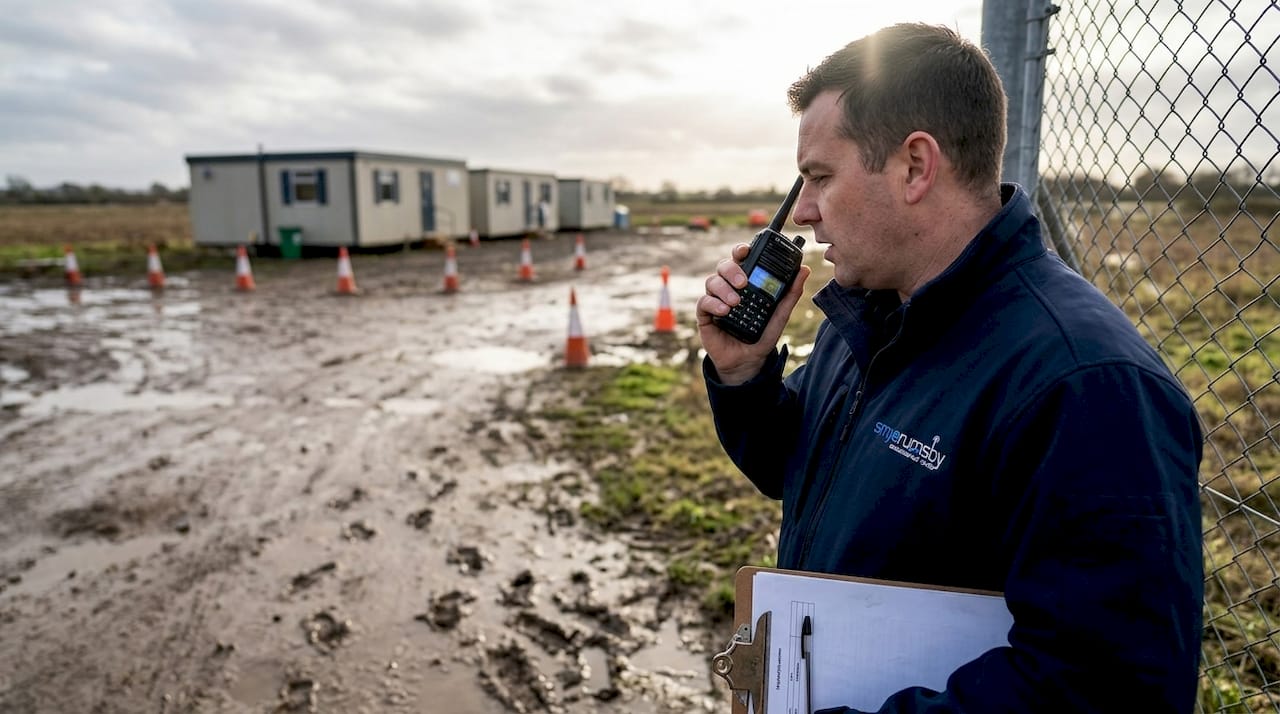
Not all two-way radios are built the same, and choosing the wrong type for your environment creates real operational problems. The right radio features vary significantly, from rugged water-resistant models for construction to hands-free units for healthcare.
Form factor options:
- Handheld (portable) radios: The most common type. Worn on a belt or vest, used across virtually every sector.
- Vehicle-mounted radios: Fixed to a vehicle dashboard, offering higher power output and extended range. Common in logistics and security patrol.
- Base station radios: Fixed units used in control rooms or reception areas, often acting as the hub of a wider radio network.
Here is a comparison of sector-specific requirements:
| Sector | Key requirements | Recommended features |
|---|---|---|
| Construction | Durability, outdoor range | IP67 waterproofing, rugged casing, long battery |
| Security | Secure communication, discretion | Encryption, earpiece compatibility, GPS tracking |
| Healthcare | Hygiene, ease of use | Smooth casing for sanitising, VOX hands-free, alarm function |
| Warehousing | Noise resistance, group comms | Loud speaker, channel scanning, multi-site capability |
| Events | Flexibility, short-term use | Lightweight, simple controls, rental options |
For construction-specific radios, ruggedness is non-negotiable. Devices rated to IP67 or higher can withstand dust, rain, and accidental drops, which are everyday realities on a UK building site.
In healthcare settings, the priorities shift. Radios must be easy to wipe down with clinical cleaning products, lightweight enough for staff to carry throughout a long shift, and capable of hands-free operation so clinicians are never distracted from patient care.
Security operations benefit most from encrypted digital radios with GPS tracking. Knowing where each officer is at any moment is not just operationally useful, it is a safety requirement.
Additional features worth considering:
- VOX (voice-operated transmission): Activates the radio automatically when the user speaks, keeping hands free
- Lone worker alarm: Triggers an alert if the device remains stationary or is not interacted with for a set period
- Man-down detection: Automatically raises an alarm if the radio tilts beyond a certain angle, indicating a fall
- GPS tracking: Enables real-time location monitoring of all radio users from a central point
Benefits of two-way radios for UK organisations
After exploring the various types available, it is worth examining why so many UK organisations continue to rely on two-way radios for critical operations rather than switching entirely to smartphones.
Two-way radios outperform mobile phones in instant communication, reliability during emergencies, and group messaging, all of which are critical for safety compliance.
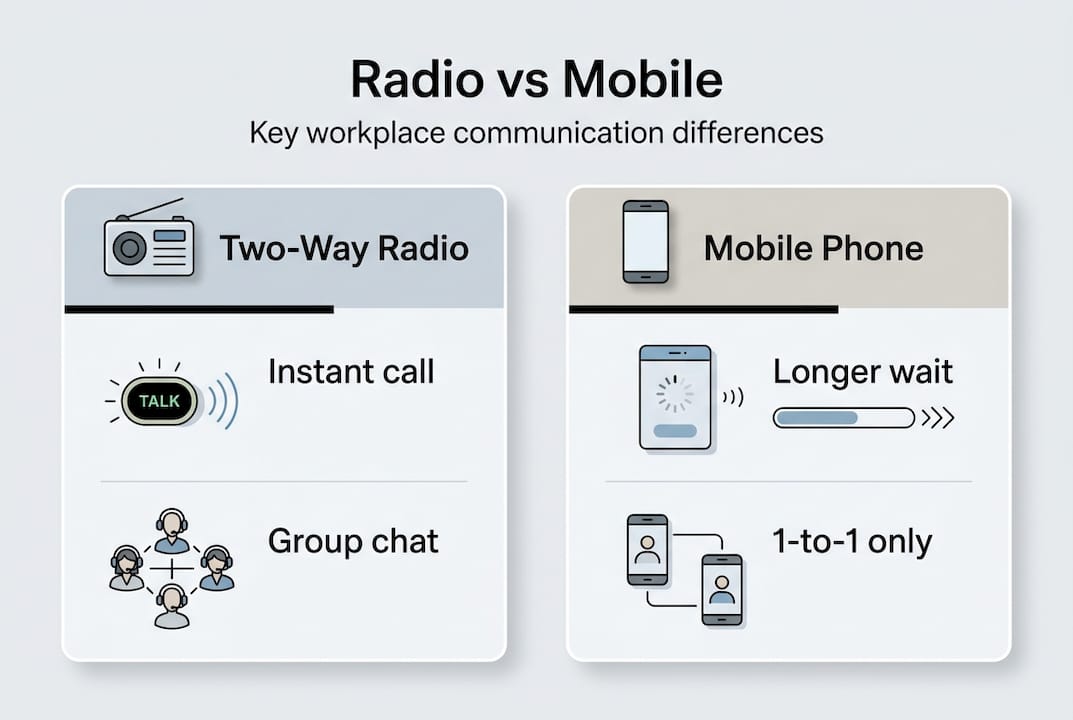
Here is a direct comparison of the key performance factors:
| Factor | Two-way radio | Mobile phone |
|---|---|---|
| Connection time | Instant (under 1 second) | 5 to 30 seconds |
| Network dependency | None | Requires a signal or Wi-Fi |
| Group broadcast | Simultaneous to all users | Requires group call setup |
| Battery life | 12 to 24 hours is typical | 6 to 12 hours is typical |
| Durability | Industrial grade available | Consumer grade |
| Ongoing cost | No call charges | Monthly contracts or call costs |
The cost argument alone is compelling for large teams. Once purchased or hired, two-way radios carry no per-call charges and no monthly network fees. For an organisation running 50 operatives across a site, that saving is substantial over a year.
From a compliance perspective, two-way radios directly support UK health and safety obligations. The Health and Safety at Work Act 1974 requires employers to maintain effective communication systems, particularly for emergency procedures and lone worker protection. A radio with a lone worker alarm or man-down function provides a documented, auditable layer of protection that a personal mobile phone simply cannot replicate.
Pro Tip: Document your radio communication protocols as part of your site safety plan. In the event of an incident, demonstrating that you had a structured, tested communication system in place strengthens your compliance position considerably.
Reliability in challenging environments is another decisive factor. Mobile networks can become congested during major incidents, precisely when you need communication most. Two-way radios operate on licensed or licence-exempt frequencies that are not shared with the public, keeping your channel clear when it matters.
Best practices for integrating two-way radios in your workplace
With the benefits well understood, the next step is practical implementation. Adopting two-way radios successfully is not just about buying the right hardware. It requires planning, training, and ongoing management.
Follow these steps to get it right from the start:
- Assess your coverage area first. Walk the site and identify dead zones, multi-floor challenges, or areas where signal may be blocked. This determines whether you need a repeater system and what radio power output is appropriate.
- Define your communication channels. Assign specific channels to specific teams or functions. A construction site might have one channel for groundworks, another for management, and a dedicated emergency channel.
- Write clear usage protocols. Establish rules for how and when radios are used, including call discipline (keep transmissions brief and clear), emergency procedures, and out-of-hours use.
- Train every user before deployment. Even a simple radio requires proper training to use effectively. Cover PTT technique, channel selection, battery management, and emergency procedures.
- Schedule routine maintenance checks. Inspect batteries, antennas, and casings regularly. A radio that fails mid-shift is worse than no radio at all.
- Keep a maintenance log. Record every fault, repair, and battery replacement. This supports compliance and helps identify patterns before they become operational problems.
As radio safety advice confirms, effective integration requires clear usage protocols, regular user training, and routine device maintenance for reliability. Organisations that skip the training stage often find that radios sit unused or are used incorrectly, undermining the investment entirely.
Looking at radio deployment examples from comparable sectors can also help you anticipate challenges before they arise on your own site.
Explore tailored two-way radio solutions for your sector
At Smye-Rumsby, we have been supporting UK organisations with professional communication solutions since 1948. Whether you are equipping a construction site in Kent, coordinating a security team across a large venue, or improving response times in a healthcare setting, we can help you identify the right equipment and deployment approach for your specific needs. If you are not ready to commit to a full purchase, hire a two-way radio system through our managed rental service, which includes maintained, ready-to-use equipment with no long-term obligation. For sector-specific guidance, our best two-way radios for warehouses resource is a useful starting point for understanding how professional radio selection works in practice. Speak to our team to discuss a solution built around your operation.
Frequently asked questions
What is the main advantage of using a two-way radio over a mobile phone?
Two-way radios provide instant group communication without relying on mobile networks, making them far more reliable during emergencies and in remote or noisy environments where mobile signals are weak or congested.
Which industries commonly use two-way radios in the UK?
Sectors including construction, security, healthcare, warehousing, and events widely use two-way radios for team coordination and safety, as professional radio uses across UK industries demonstrate.
Can two-way radios be used in compliance with UK health and safety requirements?
Yes. Two-way radios help organisations meet communication requirements for emergency procedures and lone worker protection, directly supporting compliance with UK workplace safety legislation.
What should an organisation consider before purchasing or hiring two-way radios?
Key factors include coverage area, required features such as hands-free operation or GPS tracking, environmental conditions, and sector-specific radio needs aligned with industry standards and regulations.