

Many organisations still picture two-way radio as a chunky walkie-talkie crackling with static. That image belongs to another era. Today’s construction sites, hospitals, security operations, and live events demand something far more capable. Digital mobile radio (DMR) has transformed professional communication, delivering crystal-clear audio, secure data transmission, and advanced features that analogue systems simply cannot match. This guide explains what DMR is, how its tier structure works, how it compares to rival technologies, and why it has become the preferred communication standard for sectors where reliable contact is not optional.
Table of Contents
- What is digital mobile radio?
- The three DMR tiers explained
- How digital mobile radio compares to other systems
- The business case for DMR in construction, healthcare, security, and events
- Practical considerations: Deploying DMR in your organisation
- Why the real value of DMR is often underestimated
- Ready to upgrade your business communication?
- Frequently asked questions
Key Takeaways
| Point | Details |
|---|---|
| DMR enhances reliability | Digital mobile radios provide clearer, more dependable communication than analogue systems. |
| Choose the right tier | Selecting from Tier 1, 2, or 3 ensures your radio system fits your operational needs and environment. |
| Superior to legacy systems | DMR outperforms older analogue radios and offers better value than high-cost alternatives in most business scenarios. |
| Critical for safety | DMR is indispensable for fast, coordinated responses in sectors where safety or efficiency is paramount. |
What is digital mobile radio?
DMR stands for Digital Mobile Radio, an open digital radio standard developed specifically for professional and commercial users. Unlike traditional analogue radios, which transmit voice as a continuous wave signal, DMR converts voice and data into digital packets before transmission. The result is noticeably cleaner audio, reduced background noise, and a platform capable of supporting far more than simple voice calls.
At its technical core, DMR uses 4FSK modulation, TDMA with 2 slots in 12.5 kHz channels, operating at 4,800 symbols per second with the AMBE+2 codec for voice encoding. In practical terms, TDMA (Time Division Multiple Access) means two separate conversations can share a single channel simultaneously, effectively doubling capacity without requiring additional spectrum. This is a significant advantage for busy sites with large teams.
Key features of DMR include:
- Individual and group calling, allowing targeted communication without broadcasting to all users
- Text messaging and data transmission, supporting job ticketing and status updates
- Advanced signalling, including GPS location, emergency alerts, and lone worker monitoring
- Encryption options, protecting sensitive communications in security and healthcare environments
Pro Tip: Most DMR radios can operate in analogue mode as well as digital, which makes transitioning from older equipment far more manageable. Your teams can keep working while you phase in the new system gradually.
For organisations considering an upgrade, reviewing a digital mobile radio overview is a practical starting point before committing to any specific equipment.
The three DMR tiers explained
DMR is not a single product. It is structured into three distinct tiers, each designed for a different scale and type of operation. Understanding these tiers helps organisations choose the right level of investment and capability.
| Tier | Licence required | Typical use | Key characteristic |
|---|---|---|---|
| Tier 1 | No | Small sites, personal use | Licence-free, limited range |
| Tier 2 | Yes | Construction, healthcare, security, events | Robust, scalable, feature-rich |
| Tier 3 | Yes | Large public safety, complex networks | High-capacity trunked systems |
Tier 1 operates on licence-free frequencies and suits very small sites or casual use. However, Tier 1 is prone to interference in busy environments, making it unsuitable for professional operations where reliability is essential.
Tier 2 is the workhorse of professional DMR. It requires an Ofcom licence but delivers the stability, range, and feature set that construction managers, healthcare facilities, security teams, and event organisers depend upon. Most UK businesses operating in these sectors use Tier 2 as their primary system.
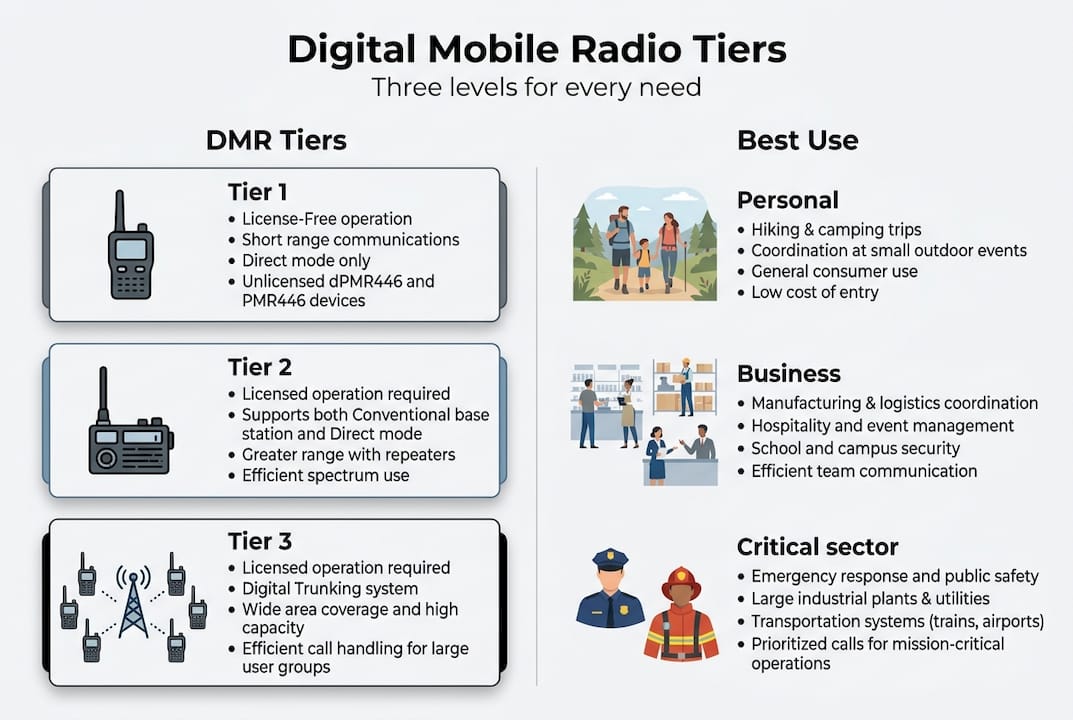
Tier 3 supports trunked networks, where channels are allocated dynamically across a pool, maximising efficiency for very high-traffic environments. This tier is typically associated with large public safety organisations and complex multi-site operations.
Key points to bear in mind across all tiers:
- Basic voice interoperability between different manufacturers is generally supported
- Advanced features such as text messaging or GPS may vary between brands
- Dual-mode radios support migration between analogue and digital, protecting existing investment
For organisations running radio options for mixed fleets, Tier 2 with dual-mode capability is almost always the most practical and cost-effective path forward.
How digital mobile radio compares to other systems
When evaluating communication technology, decision-makers often weigh DMR against two main alternatives: traditional analogue radio and TETRA (Terrestrial Trunked Radio). Each has its place, but the differences matter considerably depending on your operational requirements.
| Feature | Analogue radio | DMR | TETRA |
|---|---|---|---|
| Audio quality | Moderate | High | Very high |
| Data capability | Minimal | Good | Excellent |
| Cost | Low | Moderate | High |
| Spectrum efficiency | Low | High | High |
| Interoperability | Wide | Good | Mission-critical standard |
The core distinction is straightforward. DMR is commercial and lower-cost compared to TETRA, which is designed for mission-critical, high-interoperability environments such as emergency services. Analogue radio lacks the data capacity and audio retention that modern operations require.
Here is a practical summary of when each technology fits best:
- Analogue radio suits very small operations with minimal communication needs and tight budgets, where digital features are not required.
- DMR is the right choice for most commercial and industrial organisations, offering superior audio, data features, and spectrum efficiency at a manageable cost.
- TETRA is appropriate where absolute interoperability with emergency services is essential, or where the highest levels of encryption and resilience are non-negotiable.
For the vast majority of businesses in construction, healthcare, security, and event management, DMR delivers the right balance of capability, reliability, and value. TETRA’s additional cost is only justified when mission-critical interoperability with blue-light services is a firm requirement.
Exploring real-world radio examples across different sectors can help clarify which technology genuinely fits your operational profile.
The business case for DMR in construction, healthcare, security, and events
DMR’s technical strengths translate directly into operational benefits for the sectors that depend most on reliable communication. The global DMR market reflects this demand clearly: valued at $4.15 billion in 2020, it is projected to reach $11.49 billion by 2030, representing a compound annual growth rate of 11.1%, with Tier 2 remaining the dominant segment.
This growth is not driven by technology enthusiasm alone. It reflects genuine operational need.
Construction teams coordinate crane lifts, manage safety alerts across large sites, and protect lone workers in remote areas. A missed radio call during a lift operation is not an inconvenience; it is a safety risk. DMR’s group calling and emergency alert functions address this directly.
Healthcare facilities use DMR to manage clinical team call-outs, coordinate maintenance across large buildings, and ensure rapid response to patient safety incidents. Clear, instant communication between departments reduces delays that matter in clinical settings.

Security operations rely on DMR for crowd management, emergency coordination, and confidential messaging. Encrypted channels ensure sensitive information stays within the team.
Event management teams coordinate multiple departments simultaneously, from logistics and guest services to safety and technical crews. DMR’s ability to support multiple talk groups on a single system keeps everyone connected without confusion.
Key benefits across all four sectors include:
- Improved situational awareness through real-time voice and data
- Faster incident response with emergency alert and GPS functions
- Lone worker protection through man-down and timer features
- Scalability to grow with your operation
Pro Tip: If your organisation is exploring DMR for the first time, reviewing radio upgrades in education provides a useful case study of how a phased digital migration works in practice across a large, multi-building site.
Practical considerations: Deploying DMR in your organisation
Adopting DMR is a structured process rather than a simple equipment swap. Effective deployment requires careful planning to ensure the system delivers its full potential from day one.
Follow these steps to approach deployment methodically:
- Assess your communication needs. Map out how many users need radios, which areas require coverage, and what features matter most, such as GPS, lone worker, or data messaging.
- Choose the right tier. For most businesses, Tier 2 is the appropriate starting point. Tier 3 is only necessary for very large or complex operations.
- Plan your migration. If you are moving from analogue, dual-mode operation is supported by most modern DMR radios, allowing a phased transition without disrupting existing operations.
- Test coverage thoroughly. Building materials, site geography, and interference sources all affect radio performance. Conduct site surveys before finalising your infrastructure.
- Train your staff. Even the most capable radio system underperforms if users are unfamiliar with its features. Structured training ensures teams use DMR effectively from the outset.
Factors that influence system design include:
- Coverage area: Large or multi-storey buildings may require repeaters
- Number of users: Determines channel capacity and tier selection
- Feature requirements: GPS, encryption, and data messaging affect hardware choice
- Regulatory compliance: Ofcom licensing must be in place before operating Tier 2 or Tier 3 systems
Browsing available radio products gives a clear picture of the hardware options across different budgets and use cases. For organisations considering advanced dual-mode capability, the Hytera advanced radio is worth examining as a flexible solution for mixed-fleet environments.
Pro Tip: Always consult a specialist before finalising your system design. Regulatory compliance, coverage planning, and feature configuration are areas where expert guidance prevents costly mistakes.
Why the real value of DMR is often underestimated
Many decision-makers approach DMR as a straightforward feature upgrade. Better audio, more channels, some data capability. That framing misses the point entirely.
The genuine value of DMR becomes apparent not during routine operations, but during critical incidents. When a medical emergency occurs on a construction site, when a security threat develops at a crowded venue, or when a fire alarm triggers an evacuation across a large hospital, mobile phone networks become unreliable precisely when they are needed most. Network congestion, poor indoor coverage, and the time required to dial and connect all become liabilities.
DMR networks stand apart in these moments. Instant push-to-talk voice, dedicated channels that are not shared with the public, and emergency alert functions that notify the whole team simultaneously. These are not premium features. They are the reason radio benefits in practice consistently demonstrate value that goes beyond the specification sheet.
The sectors that benefit most are precisely those where seconds and clarity can determine outcomes. It is not just about clearer sound or data capacity. It is about reliable safety in real time, and that is a case that deserves to be made more forcefully when organisations are weighing their communication investment.
Ready to upgrade your business communication?
Smye-Rumsby has been supporting organisations across the South East of England with professional communication solutions since 1948. We specialise in business DMR solutions tailored to the specific demands of construction, healthcare, security, and event management. Whether you are ready to invest in a full digital system or want to explore your options before committing, our team provides straightforward, expert guidance.
Not sure whether to buy or hire? Our radio hire guidance explains when hiring makes more sense than purchasing outright, and our radio hire services offer flexible short and long-term options to suit your operational timeline. Speak with us to find the right fit for your organisation.
Frequently asked questions
How is digital mobile radio different from analogue two-way radio?
DMR uses digital signals for clearer audio, greater channel capacity, and advanced features such as text messaging and GPS, whereas analogue radios transmit voice as a continuous wave with more limited functionality.
Do DMR radios need a licence in the UK?
Tier 1 devices are licence-free for personal use, but Tier 2 and Tier 3 systems require an Ofcom licence for business operation in the UK.
Can DMR radios talk to analogue radios?
Many DMR radios support dual-mode operation, enabling communication with analogue radios during a phased migration to digital systems.
What is the most commonly used DMR tier for businesses?
Tier 2 is dominant in the commercial sector, offering licensed, reliable operation with the advanced features that most UK businesses in construction, healthcare, security, and events require.
Why choose DMR over TETRA for business communication?
DMR is more cost-effective than TETRA and delivers excellent audio quality and feature sets for most commercial needs, with TETRA reserved for environments requiring the highest levels of mission-critical interoperability.
Recommended
- Digital Mobile Radio DMR – Smye-Rumsby – Experts in Two-Way Radios and Marine Electronics
- Maximise security with two-way radios: essential guide
- Why radio systems are vital for UK construction site safety
- Radio Solutions for Mixed Fleets (Analogue & Digital) – Smye-Rumsby – Experts in Two-Way Radios and Marine Electronics