
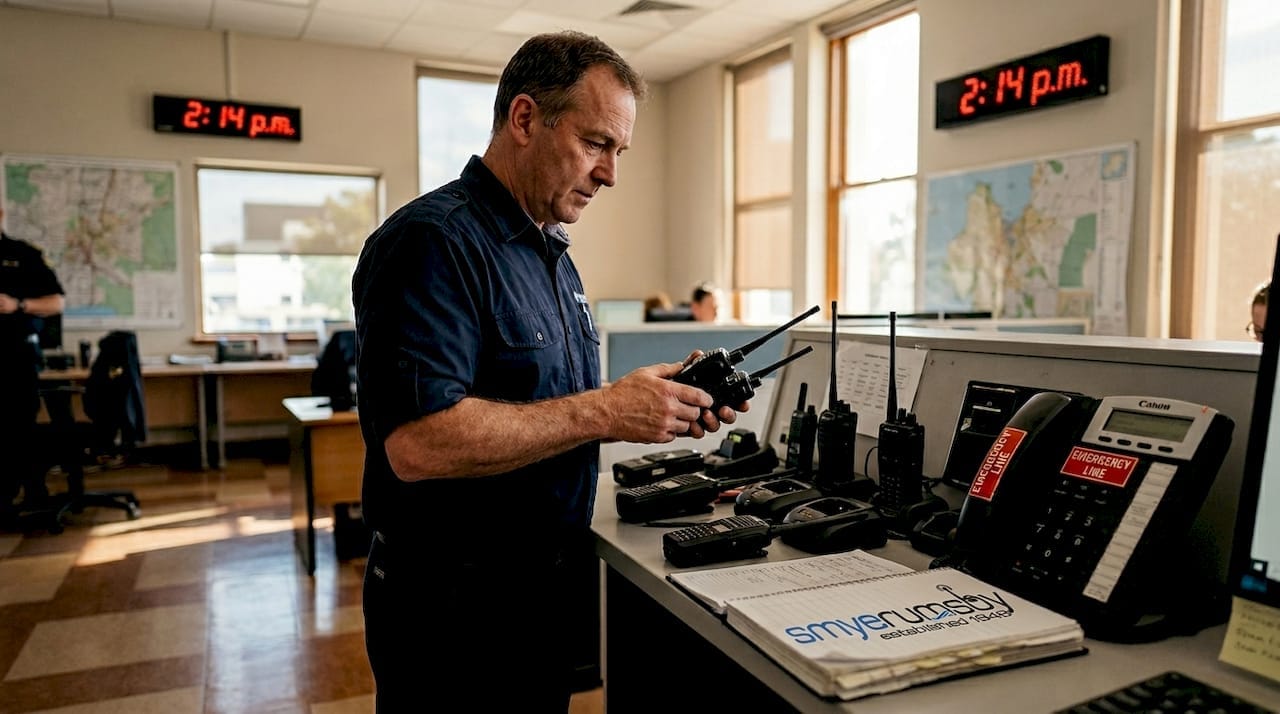
Safer Communication Solutions for Operations
- Emergency communication in 2026 emphasizes reliability, interoperability, and resilience across sectors.
- UK’s £180 million investment in resilient infrastructure supports seamless emergency services operations.
- Layered solutions combining two-way radios, ESN devices, and cloud apps ensure adaptable and robust communication.
Emergency communication in 2026 is more demanding than ever. Operational managers across construction, healthcare, and security face a rapidly shifting landscape where technology, regulation, and risk converge simultaneously. The ESN transitioning to 4G/5G LTE is replacing the legacy Airwave TETRA network by 2028 to 2029, reshaping how critical services communicate at every level. Choosing the wrong solution now means costly disruption later. This guide reviews the proven and emerging options available to UK operational managers, giving you a clear framework to assess, compare, and select communication solutions built for safety, efficiency, and long-term readiness.
Table of Contents
- How to evaluate emergency communication solutions in 2026
- Top emergency communication solutions for UK operations
- Comparison of solution types: strengths and best-fit use cases
- Emerging trends: what to watch in 2026 and beyond
- A practical perspective: why integration and adaptability trump ‘latest tech’
- Explore trusted solutions for your next step
- Frequently asked questions
Key Takeaways
| Point | Details |
|---|---|
| Set clear criteria | Identify reliability, compliance, and future readiness as must-haves for any emergency communication solution. |
| Mix solutions for resilience | Layer established systems like two-way radios with cloud or ESN tools to ensure communication never fails. |
| Watch key trends | Monitor AI, integrated networks, and new government-funded infrastructure to future-proof your choices. |
| Integration beats novelty | Choosing adaptable, user-friendly systems matters more than simply having the latest technology. |
How to evaluate emergency communication solutions in 2026
Selecting the right emergency communication solution requires more than comparing specifications. You need a structured approach that accounts for your operational environment, your compliance obligations, and the direction the industry is heading.
Start with five core criteria when assessing any solution:
- Reliability: Can the system maintain clear voice and data under pressure, in poor weather, or in signal-limited environments?
- Interoperability: Does it work alongside your existing equipment and connect with other agencies or teams?
- Resilience: What fail-safes exist if primary infrastructure is disrupted?
- Regulatory compliance: Does it meet current UK standards and anticipate forthcoming changes?
- Scalability: Can it grow with your organisation without requiring a complete overhaul?
Infrastructure resilience has become a pressing concern. The UK government is investing £180 million in resilient timing infrastructure specifically to protect emergency services from satellite signal disruption. This investment signals how seriously authorities are treating the risk of communication failure at a national level.
Operationally, your teams need instant connectivity, clear voice quality, and devices they can operate under stress without lengthy training. Forward-looking criteria matter too. AI integration, secure video transmission, and encrypted messaging are no longer future features; they are becoming baseline expectations for serious operations. When evaluating suppliers, always review their guidance on choosing the right radio system and confirm they follow radio equipment safety standards for professional environments.
For organisations operating across language groups or international partnerships, solutions that support secure multilingual communication add a further layer of operational value.
Pro Tip: Always request detailed service-level agreements and after-hours support guarantees when reviewing supplier proposals. A system that fails at 2am on a critical site is only as good as the response time behind it.
Top emergency communication solutions for UK operations
With clear evaluation criteria in place, it is worth examining the leading solution types available to UK operations today.
Two-way radios remain the backbone of emergency communication across construction, security, and event management. They offer instant group communication, exceptional battery life, and robust housings designed for demanding physical environments. No mobile signal is required, which makes them uniquely reliable in basements, remote sites, and signal-dead zones. Review the full case for two-way radios in emergencies to understand why they remain a first choice.

ESN-enabled devices are now actively in use by police, fire, and ambulance services. The ESN enabling voice, video, and data integration represents a significant step forward for multi-agency coordination, allowing seamless information sharing across services during major incidents.
Body-worn cameras are increasingly standard in security and healthcare. They capture real-time incident footage, support instant evidence upload, and act as a deterrent. Their value in protecting staff and supporting post-incident review is well established.
Cloud push-to-talk (PTT) applications connect mobile phones, tablets, radios, and desktop computers on a single platform. They are flexible, cost-effective, and ideal for organisations with dispersed teams or hybrid working arrangements.
“ESN adoption is rightly prioritising voice reliability and parity with existing systems. Advanced features will phase in as trust and familiarity grow across services.”
Pro Tip: Combine solutions for layered redundancy. A two-way radio network as your primary channel, backed by a cloud PTT application, gives your teams a reliable fallback if one system is disrupted. See how organisations are improving workplace safety with this kind of layered approach.
For a structured overview of equipment types, the emergency communication equipment list provides a practical starting point.
Comparison of solution types: strengths and best-fit use cases
Having reviewed the leading options, a side-by-side comparison helps you match the right solution to your specific environment.
| Solution type | Reliability | Coverage | Learning curve | Cost | Best-fit sector |
|---|---|---|---|---|---|
| Two-way radio | Very high | Site-based, no signal needed | Low | Low to medium | Construction, security, events |
| ESN device | High (growing) | Nationwide 4G/5G | Medium | Medium to high | Emergency services, multi-agency |
| Body-worn camera | High | Dependent on upload network | Low | Medium | Security, healthcare |
| Cloud PTT app | Medium to high | Mobile/Wi-Fi dependent | Low | Low | Logistics, healthcare, retail |
The ESN has been tested with over 300 devices during major events including New Year’s Eve in London, demonstrating its capacity under real operational pressure.
To match a solution to your team’s risk profile, follow these steps:
- Assess your environment. Noisy, outdoor, or signal-limited sites favour two-way radios. Multi-agency or data-heavy operations benefit from ESN devices.
- Define your primary risk. If evidence capture is critical, body-worn cameras are non-negotiable. If cross-team coordination is the priority, cloud PTT adds flexibility.
- Review your compliance requirements. Healthcare environments carry specific data protection obligations; ensure any solution meets those standards.
- Consider your team’s familiarity. Solutions with a steep learning curve reduce effectiveness under pressure. Prioritise platforms your teams can operate confidently.
- Plan for failure. Every primary system needs a backup. Build redundancy into your selection from the outset.
For sector-specific guidance, review the detailed construction site communication guide and the advice on maximising radio security for security operations.
Emerging trends: what to watch in 2026 and beyond
The solutions available today are evolving quickly. Understanding the trends shaping emergency communications helps you invest in platforms that will remain relevant.
AI predictive alerting and AV/IP network convergence are beginning to roll out across the sector. Machine learning tools can now detect unusual audio patterns, trigger alerts before incidents escalate, and support faster decision-making during complex events.
| Trend | Status in 2026 | Impact on operations |
|---|---|---|
| AI-powered alerting | Early rollout | Faster incident detection and response |
| AV and IP network convergence | Active development | Greater situational awareness across sites |
| Resilient timing infrastructure | Funded and in progress | Protection from satellite disruption |
| ESN full rollout | Ongoing, voice parity by 2028 | Nationwide interoperability for emergency services |
The £180 million infrastructure investment specifically targets resilience against global satellite disruption, a risk that has grown significantly as operations depend more heavily on GPS-linked timing systems.
When future-proofing your communication strategy, consider the following:
- Choose platforms with regular firmware and software update cycles
- Prioritise suppliers with a clear product roadmap and willingness to discuss it
- Invest in equipment that supports integration with AI and data analytics tools
- Anticipate compliance changes and confirm your supplier monitors regulatory developments
- Avoid locking into proprietary systems that cannot connect with wider infrastructure
For practical context on how these tools apply in real operations, the practical radio use examples resource illustrates how organisations are already adapting.
A practical perspective: why integration and adaptability trump ‘latest tech’
There is a pattern we see repeatedly across industries. An organisation invests in the newest device or platform, only to find it cannot connect with their existing systems, or that staff revert to old habits under pressure because they were never properly trained on the new equipment.
The most effective emergency communication setups are rarely built around a single cutting-edge product. They are built around layers. Two-way radios handle the core, moment-to-moment communication because they are instant, familiar, and independent of external networks. Cloud PTT adds flexibility for dispersed teams. Body-worn cameras create accountability and evidence trails. Each layer supports the others.
“Most communication failures during incidents occur not because of equipment malfunction, but because systems cannot connect with each other or staff lack the confidence to use them under pressure.”
Adaptability matters more than novelty. A platform that integrates with your existing infrastructure, scales as your team grows, and can be updated as regulations change will consistently outperform a standalone product with impressive specifications but poor interoperability. Invest in real safety improvements by focusing on what your teams will actually use, and test those integrations before committing.
Explore trusted solutions for your next step
If you are currently assessing your emergency communication options for 2026, Smye-Rumsby offers a range of professional-grade solutions built for UK operational environments. You can explore two-way radio hire to trial equipment before committing to a purchase, giving your teams hands-on experience with real-world performance. For organisations operating in coastal or offshore environments, our marine communications range provides reliable, compliant solutions. Security and healthcare teams looking to strengthen incident management will find our body-worn camera solutions effective and straightforward to deploy. Contact us to arrange a demonstration or discuss which combination of solutions best fits your sector and risk profile.
Frequently asked questions
What is the ESN and how does it impact UK emergency communications in 2026?
The ESN is replacing the legacy Airwave TETRA network and will support voice, data, and video for emergency services, with significant deployment milestones already reached in 2026. It enables seamless multi-agency communication at a national scale.
Why does resilient timing infrastructure matter for emergency communications?
Timing infrastructure underpins the synchronisation of call and data systems. The £180 million UK investment protects these systems from satellite disruption, ensuring critical services remain operational during infrastructure failures.
Should we upgrade to cloud push-to-talk or wait for ESN full rollout?
Cloud PTT is effective now for cross-team coordination and flexible communication. The ESN full voice service is expected in Q1 2028, so a hybrid approach using both technologies provides the best coverage and reliability in the interim.
What are the most reliable options for harsh environments?
Two-way radios and ESN-enabled devices are the most trusted choices for demanding conditions. Two-way radios operate without mobile signal, while ESN devices support multi-agency coordination across construction and security environments.