
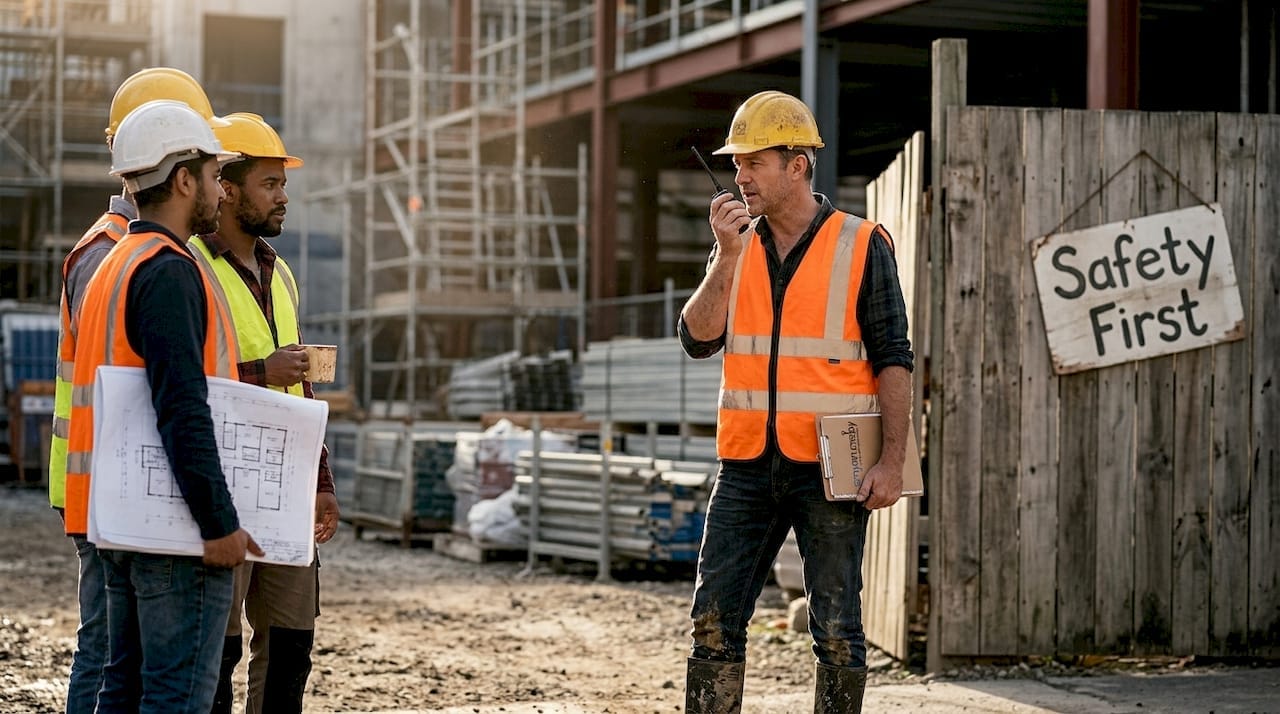
Poor communication on construction sites carries real consequences. Up to 30% of project costs can be lost to rework driven by miscommunication, while delays and safety incidents follow closely behind. For construction project managers and site supervisors, the ability to coordinate clearly, quickly, and consistently is not a nice-to-have. It is a fundamental part of keeping people safe and projects on track. This guide walks through how to assess your communication needs, select the right tools, embed daily habits, and build the kind of reliable system that supports your team from groundworks to handover.
Table of Contents
- Assessing communication needs and risks on site
- Core tools and channels: methods for clear communication
- Best practices for day-to-day site communication
- Tech and teamwork: integrating solutions for reliability
- Why ‘communication culture’ matters more than any single tool
- Enhance your site with expert communication solutions
- Frequently asked questions
Key Takeaways
| Point | Details |
|---|---|
| Assess risks upfront | Building communication into your site risk assessment prevents costly errors and accidents. |
| Choose the right channel | Match your communication tool—radio, face-to-face, written—to the message and working conditions. |
| Build daily habits | Regular briefings and handovers ensure everyone stays safe and informed, every shift. |
| Blend tech and culture | Technology supports communication, but lasting results come from trust, inclusion, and leadership. |
Assessing communication needs and risks on site
Before selecting any tool or drafting any protocol, you need to understand what your site actually requires. Communication planning should begin at the risk assessment stage, not after. The HSE’s guidance on human factors is clear: identifying communication needs during risk assessment, choosing an appropriate medium, and considering language and timing are all key principles for safety-critical communications.
Every site has its own combination of hazards. A high-rise steel frame project carries different communication risks than a groundworks contract or a busy refurbishment in an occupied building. Noise from machinery, distance between workers, restricted sightlines, and work at height all affect how reliably a message can be sent and received. A thorough risk assessment guide will help you map these factors before they become incidents.
The following situations are where communication failures are most likely to cause harm:
- Lifting operations: Crane and hoist work requires precise, real-time coordination between operators and banksmen.
- Confined space entry: Workers inside confined spaces need a reliable link to a standby person at all times.
- Excavation and groundworks: Ground conditions can change rapidly, and workers need to escalate concerns without delay.
- Work at height: Falls account for a significant share of UK construction fatalities, and clear stop-work signals are essential.
- Shift handovers: Information gaps between outgoing and incoming teams create hidden risks.
- Permit-to-work systems: Any task requiring a formal permit demands accurate, documented communication.
Matching your communication method to the risk is the next step. Verbal communication works well for small teams in quiet areas. Construction radio systems are the preferred choice where distance, noise, or urgency make face-to-face impractical. Visual signals, including hand signals and signage, support situations where noise or language barriers apply.
| Risk factor | Suggested communication method | When to escalate |
|---|---|---|
| High noise levels | Two-way radio or visual signals | Immediately if contact is lost |
| Work at height | Radio with dedicated channel | Any near-miss or stop-work situation |
| Confined space entry | Hardwired or radio link to standby | If no response within agreed interval |
| Language barriers | Visual aids, interpreter, or translation device | Before any safety-critical task begins |
| Shift handover | Written logbook plus verbal briefing | Any unresolved hazard from previous shift |
The HSE emphasises that safety-critical communications must be planned, not improvised. Identifying the right medium and timing before work begins is what separates a managed risk from an unmanaged one.
Core tools and channels: methods for clear communication
Once you have mapped your risks, the next step is selecting the right tools. The appropriate medium and method is pivotal for safety-critical messages, and no single channel works for every situation. The goal is to have a toolkit that covers the full range of scenarios your site will face.
| Method | Advantages | Limitations |
|---|---|---|
| Two-way radio | Instant, hands-free, works across distance and noise | Requires training and battery management |
| Face-to-face | High clarity, supports non-verbal cues | Not practical across large or noisy sites |
| Mobile apps | Document sharing, photo evidence, audit trails | Dependent on signal and device availability |
| Written boards | Visible to all, no technology required | Static, cannot respond to real-time changes |
For best practice methodologies in construction communication, the consensus is that no single channel is sufficient on its own. Combining radio for real-time coordination with written records for accountability and face-to-face briefings for complex instructions gives you the strongest foundation.
Here is a practical sequence for selecting and deploying a communication channel:
- Identify the message type. Is it time-critical, safety-critical, or informational? Each demands a different level of urgency and formality.
- Assess the environment. Consider noise, distance, lighting, and whether the recipient is working with their hands.
- Choose the appropriate channel. Match the channel to the message type and environment using your risk assessment findings.
- Confirm access. Ensure every worker who needs to receive the message has access to the chosen channel and knows how to use it.
- Verify receipt. For safety-critical messages, always confirm the message has been received and understood.
- Record where required. Permit-to-work instructions, hazard alerts, and shift handover information should be documented.
The two-way radio safety benefits are well established in construction, but the value depends on consistent use and clear protocols. Equally, emergency communication equipment must be tested regularly and not left as a last resort.
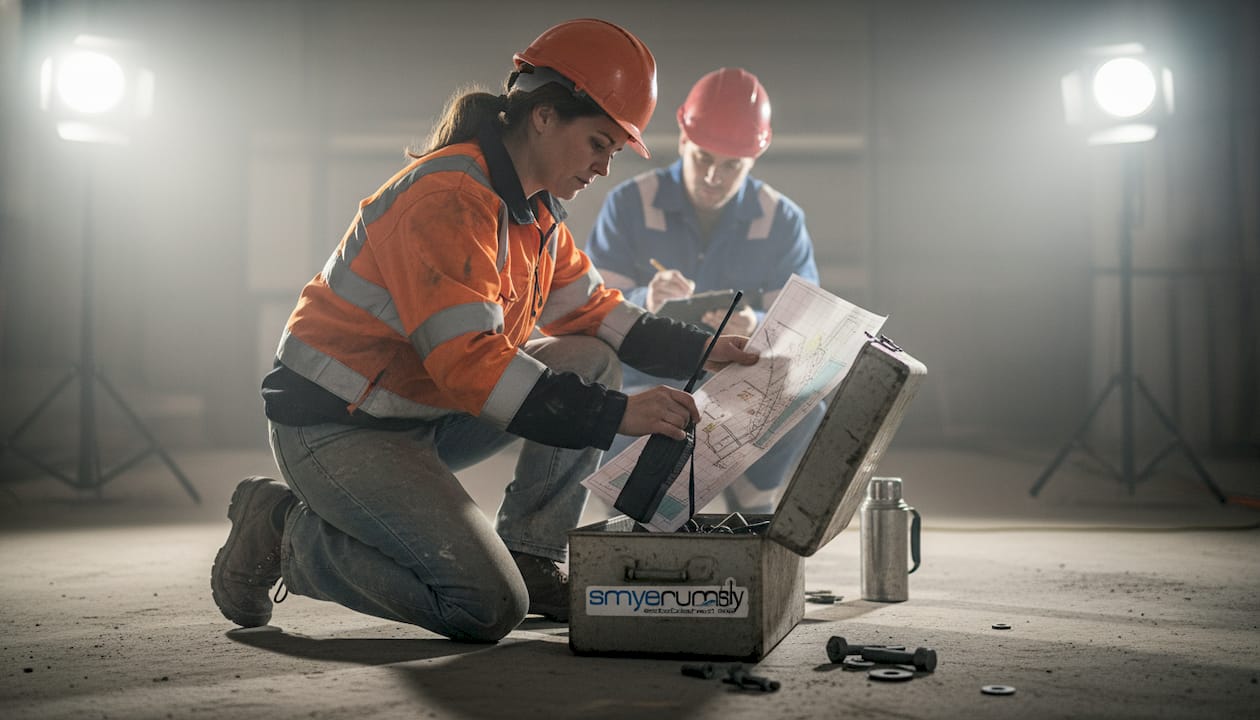
Pro Tip: Avoid industry jargon in safety-critical messages. A clear, plain instruction understood by everyone on site is always more effective than a technically precise one that only some workers follow.
Best practices for day-to-day site communication
Selecting the right methods is one thing. Embedding them in daily practice is where safety and efficiency really improve. Consistency matters more than perfection, and the habits your team builds over weeks and months are what will protect them when pressure is highest.
Safety briefings in UK construction must be structured, daily, site-specific, and evidenced. A briefing that is vague or rushed provides little protection. Here is a reliable daily routine:
- Start at a fixed time and location. Consistency builds attendance and attention.
- Confirm the day’s scope of work. Be specific about tasks, locations, and sequence.
- Identify the hazards for that day. Do not rely on generic lists; address what is actually happening on site.
- Confirm controls are in place. Check that barriers, permits, and PPE are ready before work begins.
- Assign responsibilities clearly. Every worker should know their role and who to report to.
- Record attendance and content. A signed briefing sheet provides evidence and supports accountability.
Shift handovers are another high-risk moment. Information gaps between outgoing and incoming teams are a common source of incidents. A structured handover should cover outstanding hazards, incomplete tasks, equipment status, and any near-misses from the previous shift.
Managing a diverse workforce adds another layer of complexity. Good communication ensures workers know policy, safe practices, the consequences of non-compliance, and how to access training. Where language or literacy barriers exist, the following approaches support inclusion:
- Use simple, short sentences in all written and verbal communications.
- Provide safety information in workers’ first languages where possible.
- Use photographs, diagrams, and colour coding to reinforce written instructions.
- Pair workers with a bilingual colleague or supervisor for safety-critical tasks.
- Explore translation and multilingual tools to support real-time communication across language barriers.
For further guidance on workplace communication essentials, reviewing established frameworks can help managers build more structured daily routines.
Pro Tip: Visual communication is not a workaround. For sites with mixed literacy levels or multilingual teams, a well-designed visual instruction can be more reliable than a written one.
Tech and teamwork: integrating solutions for reliability
To fully embed good communication, it is essential to combine reliable technology with strong team habits. Technology can create speed and reach, but it cannot replace the trust and clarity that comes from consistent human interaction.
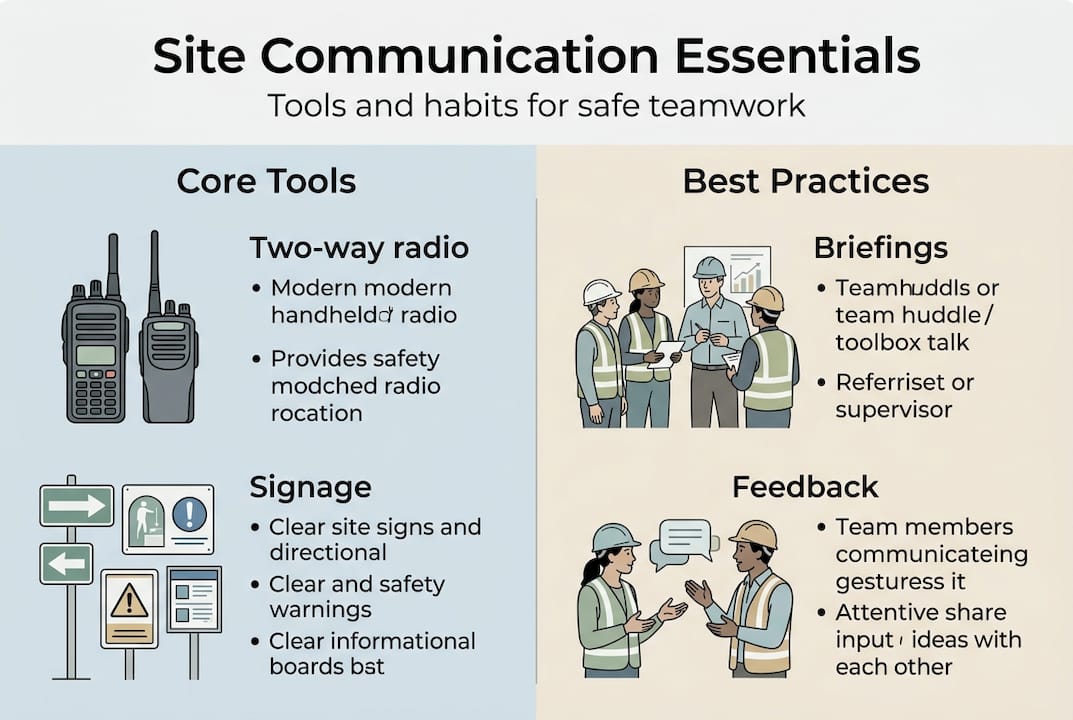
One of the most effective steps is establishing a single source of truth for site information. Whether that is a physical logbook, a central noticeboard, or a digital platform, every team member should know where to find current information on hazards, permits, and task status. Effective methodologies such as a defined chain of command and central platforms add genuine value, but they cannot replace trust-building face-to-face interaction.
A reliable site communication system should include the following:
- Dedicated radio channels for different work areas or teams, reducing interference and confusion.
- Clear escalation paths so every worker knows who to contact and how in an emergency.
- Regular equipment checks to confirm radios, chargers, and backup devices are operational.
- Documented protocols for routine messages, near-miss reporting, and emergency response.
- Feedback mechanisms so workers can raise communication problems without hesitation.
The financial case for investing in communication is strong. £3 to £5 is saved for every £1 invested in prevention, which makes communication infrastructure one of the highest-return investments a site manager can make.
Over-reliance on digital tools without interpersonal elements consistently falls short. The most effective sites balance technology with regular face-to-face contact, especially for complex or sensitive information. Practical examples of radio use across professional settings show how two-way radio fits alongside, not instead of, other communication methods. For mission-critical environments, digital radio reliability is a key factor when selecting equipment.
For broader context on how smart platforms are shaping construction communication, reviewing current industry thinking can help managers plan future investment.
Pro Tip: Schedule a monthly review of your communication protocols. Ask your team what is working and what is not. The answers will often surprise you, and acting on them builds the trust that makes communication reliable.
Why ‘communication culture’ matters more than any single tool
The construction industry rightly invests in equipment, software, and process. But the most persistent communication failures on site are rarely about tools. They are about culture. Workers who feel they will be dismissed or blamed for raising concerns simply do not speak up. That silence is where incidents happen.
Industry guidance warns against replacing personal interaction with technology, and the reasoning is sound. A digital platform cannot notice that a worker looks uncertain. A radio cannot pick up the hesitation in someone’s voice when they are unsure whether to proceed. Those signals require human attention and a team culture where speaking up is normal, not exceptional.
Leaders set the standard. When supervisors model clear, respectful communication and genuinely act on feedback, workers follow. Inclusive briefings where questions are welcomed, near-misses are discussed without blame, and every voice is treated as worth hearing create the conditions for real improvement. Review your equipment safety tips regularly, but invest equal energy in the conversations happening around that equipment.
Enhance your site with expert communication solutions
Smye-Rumsby has supported UK construction teams with professional communication solutions since 1948. From two-way radio hire and sales to fully managed digital radio systems, the team understands the demands of active construction sites and the standards required to keep workers safe. Whether you need to equip a short-term project through radio hire or build a long-term communication infrastructure with digital radio solutions, Smye-Rumsby provides the expertise and equipment to match your site’s specific needs. Get in touch to discuss how we can support your team.
Frequently asked questions
What is the most effective way to communicate on a noisy construction site?
Two-way radios and visual signals are generally the most reliable options where noise hinders verbal communication, as they do not depend on workers being able to hear one another clearly.
How do you ensure non-English speaking workers understand key safety messages?
Using simple language, visual aids, and appropriate language considering literacy and first language ensures safety messages reach every worker clearly and inclusively.
What should a daily construction site safety briefing include?
Safety briefings in UK construction should cover the day’s work, identified hazards, controls in place, responsibilities, and references to relevant RAMS and permits.
How much does poor communication actually cost construction firms?
Up to 30% of project costs can be attributed to rework linked to poor communication, with 20% of delays and 36% of unsafe situations also connected to communication failures.