
TL;DR:
- Reliable two-way radio coverage is essential for safety and coordination at UK events.
- Proper licensing, site surveys, team training, and maintenance are crucial for effective communication.
- Rethinking team structures and adopting digital radios improve overall communication during events.
Communication failure at a large event is not just an inconvenience. It can delay emergency responses, create safety blind spots, and leave staff unable to coordinate across a busy site. For UK event organisers, reliable two-way radio coverage is the backbone of safe, smooth operations. This guide walks you through every stage, from understanding licensing requirements and conducting site surveys, to training your teams and maintaining equipment. Whether you are managing a music festival, sporting event, or corporate gathering, the steps here will help you build a communication plan that holds up under real-world pressure.
Table of Contents
- Understanding radio coverage requirements for UK events
- Pre-event planning: Site surveys and radio testing
- Training teams and radio etiquette: Avoiding user errors
- Maintenance and troubleshooting: Ensuring ongoing reliability
- A fresh perspective: What most event organisers overlook about radio coverage
- Get expert help for seamless radio coverage
- Frequently asked questions
Key Takeaways
| Point | Details |
|---|---|
| Obtain the right licence | Apply for Ofcom’s Simple UK Light or Technically Assigned licence to ensure legal radio coverage. |
| Survey your site | Pre-event testing identifies dead zones and tailors frequency choices for indoor or outdoor coverage. |
| Train your team | Staff training in radio etiquette prevents most breakdowns and keeps communication flowing. |
| Maintain and troubleshoot | Regular maintenance and tactical troubleshooting preserve coverage throughout the event. |
| Embrace modern solutions | Digital radios, multi-channel setups, and dry runs outperform old habits and ensure seamless coordination. |
Understanding radio coverage requirements for UK events
Before you order a single radio, you need to understand what “coverage” actually means in practice. Coverage is not simply whether a signal exists. It refers to consistent, clear, two-way communication across every zone your team operates in, including backstage areas, car parks, first aid posts, and crowded indoor spaces. Getting this right starts with legal compliance and the right frequency choices.
In the UK, radio use at events is regulated by Ofcom. Organisers must obtain appropriate Ofcom licensing such as Simple UK Light (£75 per five years) or Technically Assigned licences for custom frequencies. Using unlicensed frequencies risks interference, financial penalties, and, critically, communication breakdowns at the worst possible moment.
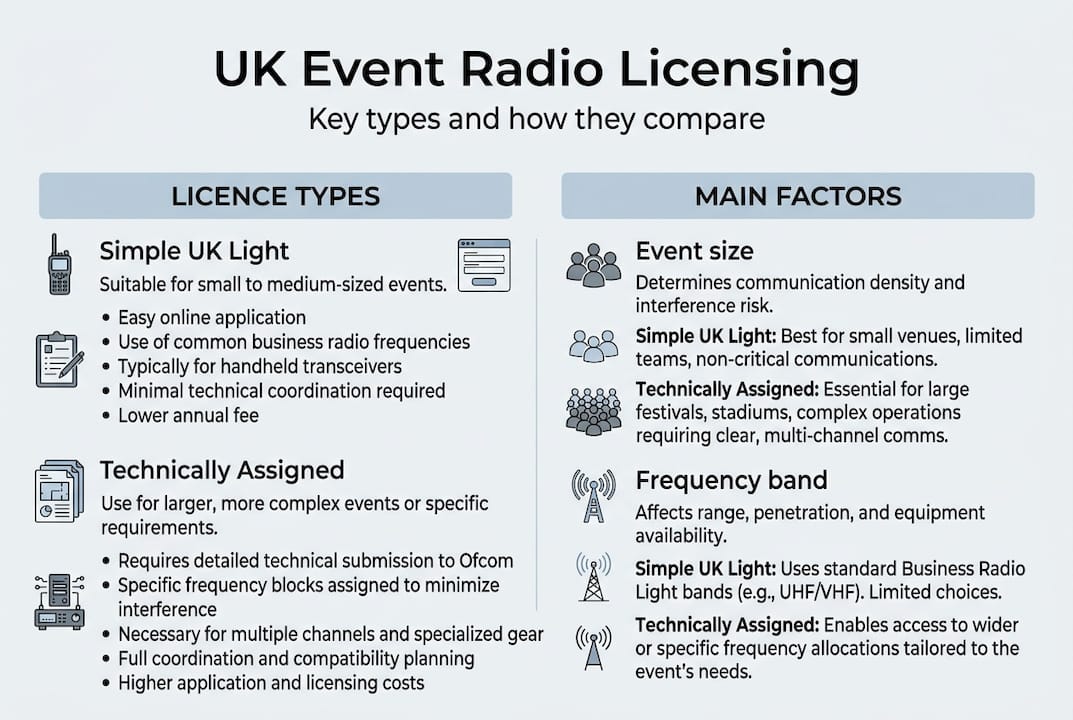
Frequency choice shapes your coverage significantly. UHF (Ultra High Frequency) signals penetrate walls, crowds, and structures well, making them ideal for indoor venues, urban festivals, and areas with dense infrastructure. VHF (Very High Frequency) signals travel further in open environments where line-of-sight is possible. Understanding the radio benefits for events helps organisers match frequency type to venue layout from the outset.
| Licence type | Best for | Frequency band | Notes |
|---|---|---|---|
| Simple UK Light | General events, nationwide | UHF | £75 per 5 years, shared frequencies |
| Technically Assigned | Large or complex events | UHF or VHF | Custom, interference-protected |
| Suppliers/Hire | Short-term hire | UHF | Licence often included in hire |
Following established radio coverage protocols helps ensure your frequency plan suits your specific event type. When planning radio hire for events, confirm that your supplier includes licensing support as part of the package.
Key licensing considerations for event organisers:
- Confirm whether your venue or local authority has existing licensed frequencies that may cause interference
- Apply for licences well in advance, particularly for Technically Assigned options which require lead time
- Ensure all hired or purchased radios operate within your licensed frequency band
- Keep licence documentation on site during the event for inspection if required
- Review your licence annually if you run recurring events, as conditions can change
Pre-event planning: Site surveys and radio testing
With licensing and frequencies sorted, the next step is mapping your venue to identify gaps in coverage before event day arrives. A thorough site survey is one of the most valuable investments you can make in event safety. It removes guesswork and replaces it with documented evidence of where radios work and where they do not.
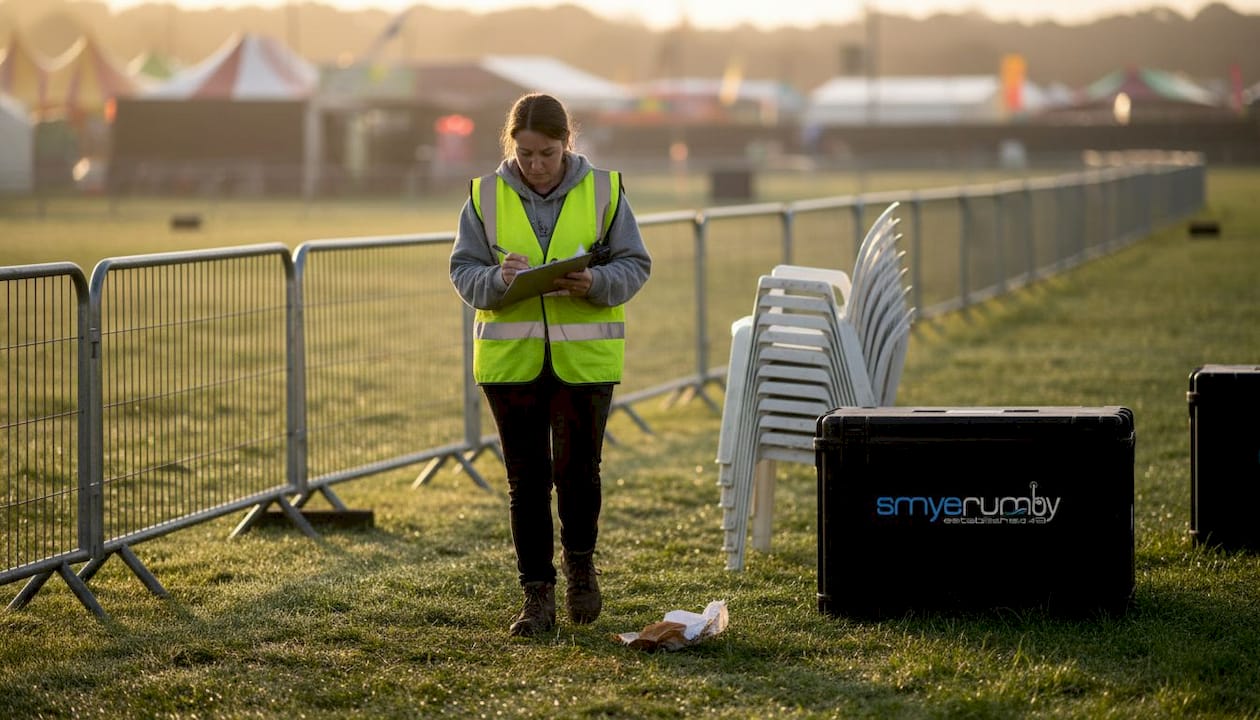
Site surveys should replicate real event conditions as closely as possible. Structures, vehicles, and even large crowds absorb and deflect radio signals. Conduct site surveys and tests from the furthest points to identify dead zones, using UHF for indoor areas and VHF for open spaces. Reviewing event radio planning examples can help you anticipate the zones most likely to cause problems.
| Feature | UHF | VHF |
|---|---|---|
| Best environment | Indoor, urban, dense crowds | Open outdoor, rural |
| Typical range | 0.5 to 2 miles | 3 to 8 miles (line-of-sight) |
| Penetration | High (walls, structures) | Lower (obstructions reduce range) |
| Common event use | Arenas, stadiums, festivals | Racecourses, airshows, open fields |
For venues with complex layouts or large footprints, consider antenna solutions for events to extend and direct coverage into difficult areas.
Essential steps for a successful site survey:
- Obtain a detailed site plan and mark all operational zones, entry points, and first aid locations
- Walk each zone with a test radio, noting signal strength and clarity at each point
- Test from the furthest points first, working inward to identify the weakest links
- Record results by zone, time of day, and radio model used
- Repeat the survey with temporary structures in place, such as stages or barriers
- Identify dead zones and plan repeater placement or frequency adjustments accordingly
- Confirm final coverage with a full-team walkthrough at least 48 hours before the event
Pro Tip: Document every test location and the time it was tested. Crowd movement significantly changes radio performance, as bodies absorb signals. A zone that works well during setup may become a dead spot once attendees fill the space.
Training teams and radio etiquette: Avoiding user errors
Even the best radio setup will underperform if your staff do not know how to use the equipment correctly. User error is, by a considerable margin, the leading cause of communication breakdown at events. Addressing this through structured training is as important as any technical preparation.
Professional radio etiquette is a skill, not an instinct. Train teams on etiquette, including NATO phonetics, brevity codes such as “Over” and “Out,” and clear channel discipline. Conduct drills before the event and label radios clearly. Research indicates that 70% of comms failures are due to user error, which means training is your single highest-impact investment.
“70% of event communication failures come down to staff error, not equipment failure. Training is the intervention that changes this statistic.”
When selecting equipment, reviewing options for the best event radios ensures your team has hardware that supports, rather than complicates, proper use. Ergonomic design, clear displays, and intuitive channel switching all reduce the likelihood of mistakes under pressure. Pairing good equipment with structured training produces the most reliable outcomes.
Common mistakes and etiquette basics to cover in training:
- Holding the push-to-talk button before speaking, not simultaneously
- Keeping transmissions brief and to the point, avoiding unnecessary conversation
- Using NATO phonetics for names, locations, and codes to avoid misunderstanding
- Waiting for a channel to clear before transmitting to prevent blocking
- Reporting radio faults immediately rather than continuing to use faulty equipment
- Wearing lanyards and using belt clips to prevent drops and loss
- Returning radios to the charging station after each shift
Pro Tip: Run a mock drill covering a simulated incident before every event. This reinforces muscle memory for correct radio use and reveals gaps in your communication plan while there is still time to fix them. Pair this with professional etiquette tools to support structured training sessions.
Maintenance and troubleshooting: Ensuring ongoing reliability
Effective training prevents most user errors, but only consistent maintenance and fast troubleshooting keep coverage reliable when conditions change during a live event. Radios are robust tools, but they are not indestructible, and neglected equipment will fail at the most inconvenient moments.
A planned maintenance routine is essential. Quarterly inspections extend radio life by 30% and prevent unexpected failures during events. Battery health is the most common cause of mid-event radio failure. Check battery charge cycles, replace ageing cells, and always carry spares. Physical inspections should cover antenna condition, speaker clarity, button responsiveness, and charging contacts.
Statistic: Quarterly checks extend equipment lifespan by 30%, significantly reducing the risk of failure during critical moments.
Troubleshooting tactics for dead spots and channel conflicts:
- Switch to an alternative channel if interference or congestion is suspected
- Move to higher ground or an open area to improve signal propagation
- Check antenna connections on both the radio and any repeater units
- Restart the radio if it has locked up or is displaying error codes
- Replace the battery immediately if signal strength is weak but the channel is clear
- Contact your radio supplier’s support line if issues persist beyond basic troubleshooting
Safe handling practices matter too. Radios dropped repeatedly, exposed to moisture without appropriate IP ratings, or stored in extreme temperatures will degrade faster than their design lifespan. Brief your team on proper handling as part of the pre-event briefing. For guidance on structuring your hire arrangement to include maintenance support, the event radio rental guide covers what to look for in a supplier agreement.
Building a simple fault log during the event also helps. If a radio is reported faulty, log the time, location, and nature of the fault. This data informs your post-event review and helps you identify patterns, such as a particular zone that repeatedly causes issues or a batch of batteries that underperform.
A fresh perspective: What most event organisers overlook about radio coverage
Most guidance on event radio coverage focuses on equipment and logistics. That is necessary, but it misses something important. The organisers who consistently achieve reliable communication are not necessarily those with the most expensive radios. They are the ones who rethink how their teams are structured around communication.
One-channel setups are a common mistake. When all departments share a single channel, traffic congestion becomes a real problem during incidents, precisely when clear communication matters most. Assigning dedicated channels to security, medical, logistics, and management creates isolation that speeds up response times and reduces confusion.
Digital radios also deserve more attention than they typically receive. Unlike analogue systems, digital radios maintain audio clarity right to the edge of their range, rather than degrading gradually. In dense crowds, this difference is significant. Reviewing radio security and encryption options is worthwhile for any event handling sensitive operational information, as digital systems support encryption that analogue cannot provide.
Finally, no technical adjustment replaces a well-run pre-event rehearsal. The dry run is where you discover that your channel plan does not match your team structure, or that a key zone has no coverage. Fix these problems in rehearsal, not on event day.
Pro Tip: Prioritise rehearsal and digital upgrades over last-minute equipment additions. One structured dry run with your full team will surface more real problems than any amount of additional hardware.
Get expert help for seamless radio coverage
Smye-Rumsby has supported UK event organisers with professional radio solutions since 1948. Whether you need to hire radios for events on a short-term basis or build a longer-term communication strategy, we offer the expertise, equipment, and licensing support to make it straightforward. Our radio rental guide helps you understand what to expect from a professional hire arrangement, including maintenance, spares, and on-site support options. For organisations based in or near Kent, our Kent radio hire service provides fast, flexible access to Motorola and Kenwood equipment with full technical support. Contact us to discuss your event requirements and arrange a site survey.
Frequently asked questions
What Ofcom licence do I need for event radio coverage in the UK?
Most organisers use the Simple UK Light licence (£75 per five years) for nationwide coverage, but events requiring custom or interference-protected frequencies will need a Technically Assigned licence instead.
How do I choose between UHF and VHF radios for an event?
Choose UHF for indoor venues, urban settings, and dense crowds where signal penetration matters. Use VHF for larger outdoor spaces where line-of-sight is possible and distances of three to eight miles are needed.
What causes most radio communication failures at events?
70% of failures are caused by user error, including poor etiquette, lack of training, and failure to follow channel discipline, rather than equipment faults.
How can I troubleshoot dead zones during an event?
Try switching channels, moving to higher ground, or adjusting antenna angles. If the problem persists, check battery levels and antenna connections before escalating to your supplier’s technical support.