
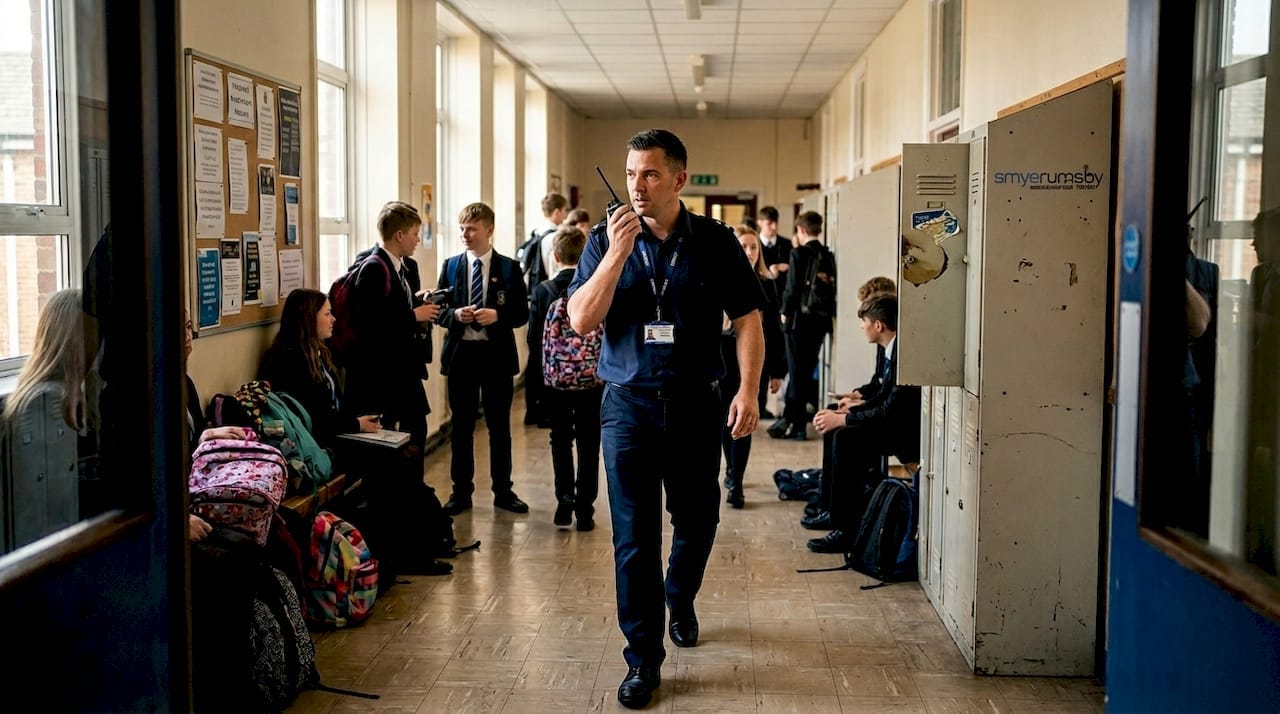
Safer Schools
- Two-way radios ensure instant, network-independent communication crucial during emergencies in schools.
- Licensed radios offer greater range and reduced interference, ideal for larger or multi-building campuses.
- Radios improve daily school operations by enabling quick coordination for events, safety, and maintenance tasks.
Mobile phones feel like the obvious answer to school communication until a real emergency arrives. Networks become congested, contacts take time to find, and calls must be made one at a time. In those critical first moments of a lockdown or medical incident, seconds genuinely matter. Two-way radios remove these barriers entirely, delivering instant group-wide communication that works independently of mobile networks. This article explains why school administrators and security managers across the UK are increasingly choosing professional radio systems to protect students, coordinate staff, and manage day-to-day operations more effectively.
Table of Contents
- How radios transform school security communication
- Licence-free vs licensed radios: What schools need to know
- Operational benefits: Beyond emergencies
- Achieving full site coverage and compliance
- A smarter investment: Radios as a modern security backbone
- Strengthen your school’s security with expert radio solutions
- Frequently asked questions
Key Takeaways
| Point | Details |
|---|---|
| Faster emergency response | Radios enable instant, school-wide communication that can save precious seconds during crisis events. |
| Superior coverage and reliability | Unlike mobiles, radios work across large campuses—even during power cuts and network failures. |
| Supports daily operations | Two-way radios streamline event management, maintenance, and coordination, improving overall school efficiency. |
| Easy compliance for UK schools | With licence-free or Ofcom-licensed models, any school can implement a secure, legal radio system. |
How radios transform school security communication
Having set the scene for reliable communications, let us examine exactly how radios outperform common alternatives in urgent security scenarios.
When an incident occurs on school grounds, the difference between a controlled response and a chaotic one often comes down to how quickly information reaches every member of staff. Mobile phones require you to unlock the device, locate a contact, and wait for a connection. A two-way radio requires a single button press. That simplicity is not a minor convenience; it is a fundamental advantage in high-pressure situations.
Two-way radios provide instant broadcasts and group communication, meaning one transmission reaches every staff member simultaneously. Whether you are managing a lockdown, coordinating a fire evacuation, responding to a fight in a corridor, or supporting a medical emergency on the sports field, every relevant person receives the same information at the same moment.
The radio communication benefits for schools extend well beyond speed. Consider the following key advantages:
- Network independence: Radios operate on dedicated radio frequencies, not mobile infrastructure. They continue to function even when mobile networks are congested or fail entirely.
- One-to-many transmission: A single call reaches all staff on the channel simultaneously, removing the need for chain-calling.
- Instant activation: Push-to-talk operation means there is no dialling, no waiting, and no missed calls.
- Site-wide coordination: A central base station or control point can oversee communication across multiple buildings from one location.
- Durability: Professional-grade radios are built to withstand drops, dust, and wet weather, making them reliable across all school environments.
“The ability to reach all staff instantly, without relying on a mobile signal, is what makes two-way radios the preferred choice for school security managers across the UK.”
Pro Tip: Assign dedicated channels for different functions, such as one for security incidents and another for general operations. This prevents channel congestion during emergencies and ensures critical messages are never buried.
Licence-free vs licensed radios: What schools need to know
Having established the value of instant, reliable communication, it is important to understand the practicalities of available radio types.
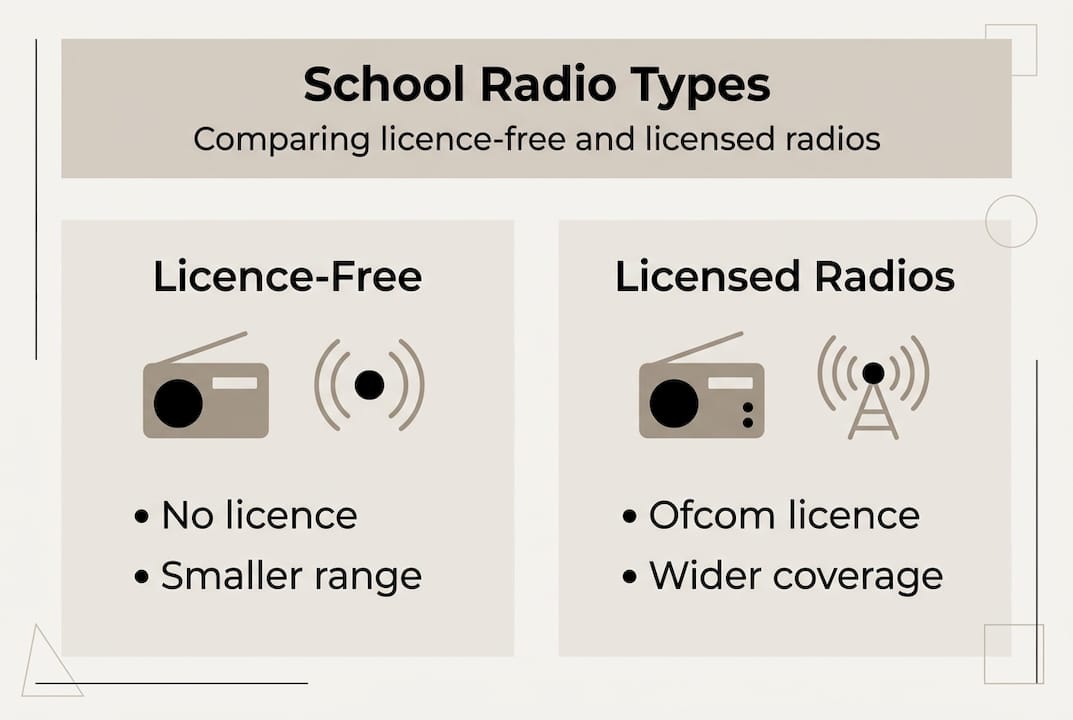
Not all two-way radios are the same, and choosing the wrong type for your site can leave you with poor coverage or unexpected compliance issues. In the UK, radios broadly fall into two categories: licence-free PMR446 models and licensed radios regulated by Ofcom.
PMR446 licence-free radios operate on a set of frequencies that anyone can use without applying for a licence. They are straightforward to deploy, cost-effective, and perfectly adequate for smaller school sites where buildings are close together. However, their transmission power is limited by law to 0.5 watts, which restricts their effective range.
Licensed radios operate on frequencies assigned specifically to your organisation by Ofcom, offering greater power, extended range, and significantly reduced risk of interference from other users. For larger secondary schools, multi-building campuses, or sites with significant structural obstacles, licensed radios are the recommended choice.
| Feature | PMR446 licence-free | Licensed radios |
|---|---|---|
| Licence required | No | Yes (via Ofcom) |
| Transmission power | Up to 0.5 watts | Up to 5 watts |
| Typical range | Up to 1 km open ground | Several kilometres with repeaters |
| Risk of interference | Higher | Low |
| Best suited for | Small primary schools | Large or multi-building sites |
| Approximate annual cost | None | From around £75 per licence |
Obtaining an Ofcom licence is a straightforward process, typically completed online, and the annual cost is modest relative to the security benefit. Schools can explore licence-free radio options as a starting point, then scale up to licensed systems as their needs grow.
A medium-sized secondary school with a main building, sports hall, and separate sixth form block, for example, would almost certainly benefit from licensed radios paired with a repeater. A small primary school operating on a single compact site may find that PMR446 handsets serve them well at a fraction of the cost.
Operational benefits: Beyond emergencies
While their emergency role is crucial, radios also deliver value in everyday operations.
The return on investment from a school radio system is not built solely on emergency scenarios. Daily operations and events amplify the value of every radio on site, making the case for investment far stronger than security alone.
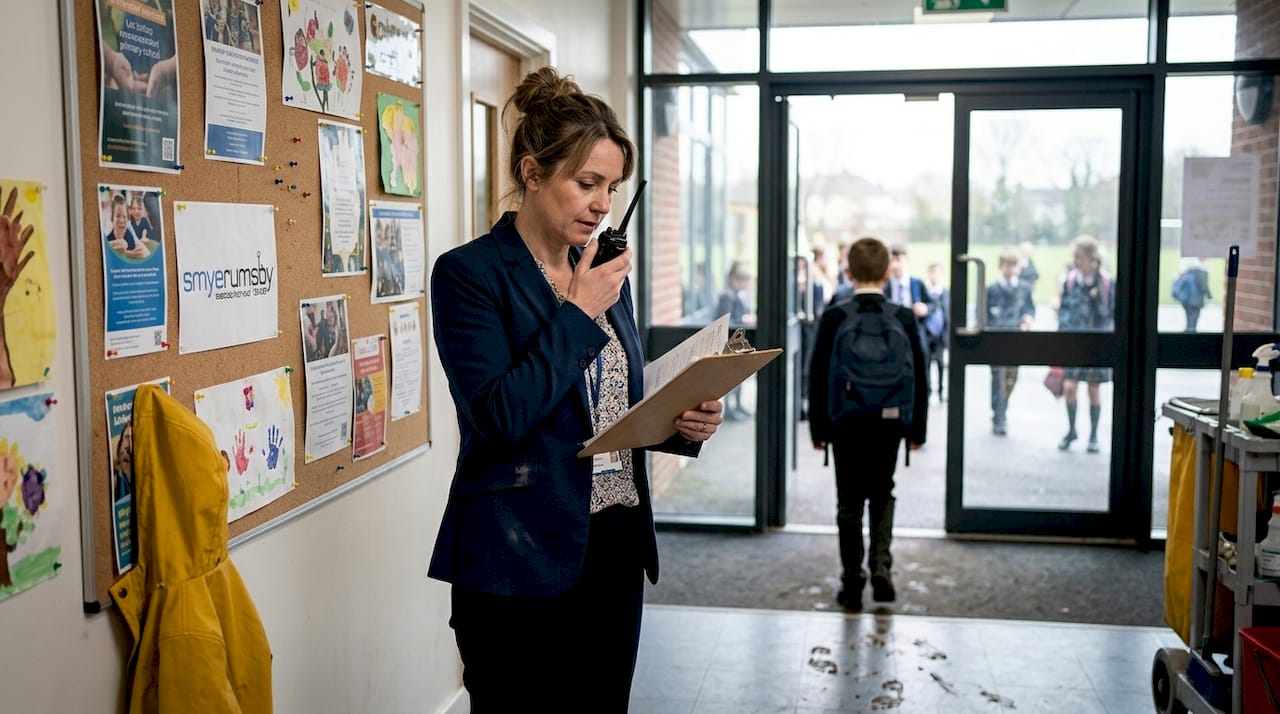
Consider how many small coordination tasks take place across a typical school day. A wet break requires rapid communication to redirect pupils indoors. A fire drill needs precise timing across multiple zones. A visiting sports team needs escorting from the gate to the changing rooms. Each of these tasks is faster, quieter, and less disruptive when managed by radio.
Here are the most impactful day-to-day applications:
- Fire drills and evacuations: Coordinate zone wardens and confirm clearance without relying on a tannoy system that may not reach all areas.
- Wet break management: Redirect duty staff instantly when weather changes, avoiding confusion and unsupervised areas.
- Maintenance and site management: Report hazards, broken equipment, or security concerns the moment they are spotted, enabling faster resolution.
- Events and open days: Manage visitor flow, car parking, and staff positioning across large outdoor areas with ease.
- Safeguarding support: Discreetly alert colleagues to a concern without alarming pupils or parents nearby.
Pro Tip: For school events such as sports days or open evenings, consider event radios in schools on a short-term hire basis if your permanent fleet is insufficient. This keeps costs manageable while ensuring full coverage.
The radio use cases across a school environment are broader than most administrators initially anticipate. Maintenance teams, site managers, reception staff, and senior leadership can all operate on the same system, reducing the reliance on runners, intercoms, and tannoy announcements that disrupt lessons. Keeping radio upkeep tips in mind from the outset also ensures your investment performs reliably year after year.
Achieving full site coverage and compliance
To truly benefit from your radio system, ensure every corner of the school is reliably covered and meets legal standards.
Purchasing radios is only the first step. Without proper planning, even the best equipment can leave blind spots in coverage that undermine the entire system during a critical moment. A structured approach to deployment makes the difference between a system that works and one that merely exists.
The starting point is always a professional site survey. This process identifies areas where radio signals are weak or blocked, such as basement rooms, dense brick structures, or large metal-framed sports halls. Armed with this information, you can make informed decisions about equipment placement and whether repeaters are required.
Repeaters extend range for challenging layouts and ensure all staff remain connected, even in areas that would otherwise fall outside the handset’s direct reach. A repeater receives a signal and retransmits it at higher power, effectively bridging gaps across large or structurally complex sites.
| School layout | Recommended solution |
|---|---|
| Small primary, single building | PMR446 licence-free handsets |
| Medium secondary, multiple blocks | Licensed radios with one repeater |
| Large campus with sports fields | Licensed radios with multiple repeaters |
| Multi-site academy trust | Networked digital radio system |
For achieving reliable coverage across your site, consider the following maintenance and compliance checklist:
- Conduct a professional site survey before purchasing or hiring equipment.
- Test coverage in all areas, including basements, stairwells, and outdoor spaces.
- Schedule quarterly battery checks and annual equipment servicing.
- Ensure all licensed frequencies are renewed with Ofcom before expiry.
- Provide brief staff training on correct radio use, channel discipline, and emergency protocols.
- Maintain a spare handset pool to cover absent staff or equipment faults.
Pro Tip: Document your radio system as part of your school’s emergency plan. Auditors and inspectors increasingly expect communication tools to be referenced within safeguarding and emergency response documentation.
A smarter investment: Radios as a modern security backbone
There is a tendency among school leaders to view two-way radios as a supplementary tool, something to reach for when the mobile network fails. We would challenge that assumption directly. In our experience working with educational institutions across the South East, the schools that treat radios as a foundation for their safety infrastructure, rather than a backup, consistently demonstrate faster incident response and more confident staff.
Mobile apps and smartphones have their place, but they depend on infrastructure that can and does fail under pressure. Radios do not. They function during power cuts, network outages, and the kind of large-scale incidents where every other system becomes unreliable. The daily operational savings from reduced disruption and faster coordination also accumulate significantly over an academic year.
The long-term financial case is equally strong. Fewer incidents, faster responses, and streamlined operations reduce costs that are harder to quantify but very real. Schools that invest in the right radio system today are not simply buying equipment; they are building a communication infrastructure that will support their safety protocols for years. Explore the security radio essentials that form the basis of a robust, future-proof system.
Strengthen your school’s security with expert radio solutions
Smye-Rumsby has been supporting organisations across the South East with professional radio communication systems since 1948. We understand the specific challenges that school administrators and security managers face, from multi-building coverage to Ofcom compliance and budget constraints. Whether you are considering a radio hire guide approach to trial equipment before committing, or you are ready to invest in a permanent system, our team provides site surveys, equipment recommendations, installation, and ongoing maintenance. Browse our full school radio product range or read our dedicated security guide to take the next practical step towards a safer, better-connected campus.
Frequently asked questions
Are two-way radios legal for schools to use in the UK?
Yes, UK schools can use licence-free radios on PMR446 frequencies without any application, or apply to Ofcom for a licence that provides greater range and protection from interference.
What emergencies are radios best suited for in schools?
Radios are particularly effective during lockdowns, fire evacuations, medical incidents, and large on-site events, where instant group broadcasts ensure every staff member receives the same information simultaneously.
How far can school radios reach?
Licence-free PMR446 radios typically cover a compact school site, while licensed models with repeaters can reliably cover large or multi-building campuses across several kilometres.
Is staff training needed to use school radios?
Very little training is required; radios are straightforward to operate, and a brief staff briefing covering channel use, radio etiquette, and emergency protocols is sufficient to ensure consistent and compliant use across the team.